
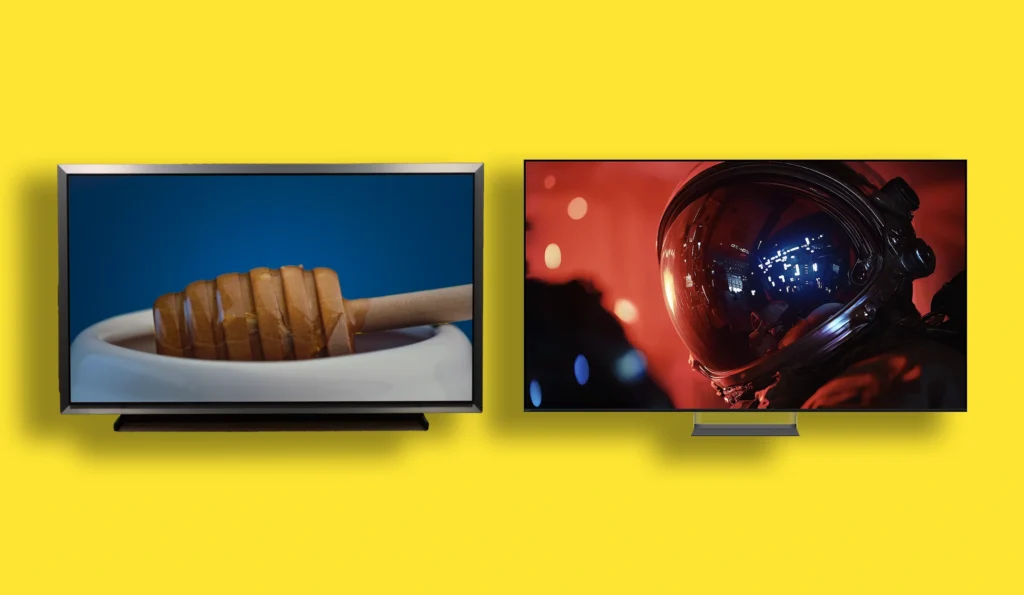
OLED is still the better technology for outright picture quality in 2026, winning on black levels, contrast, uniformity and viewing angles. RGB Mini LED wins on peak brightness, bright-room performance, screen sizes above 83 inches and freedom from burn-in worry. Buy OLED for a dark room and film-first viewing. Buy RGB Mini LED for a bright room or a very big screen.
RGB Mini LED is the TV industry’s big push for 2026, and it has been marketed harder than any display technology since the arrival of Mini LED itself. Five brands – TCL, Hisense, Samsung, LG and Sony – now have RGB-backlit sets on shelves or on the way, and more than one of them has been happy to let the phrase “OLED killer” do the rounds unchallenged.
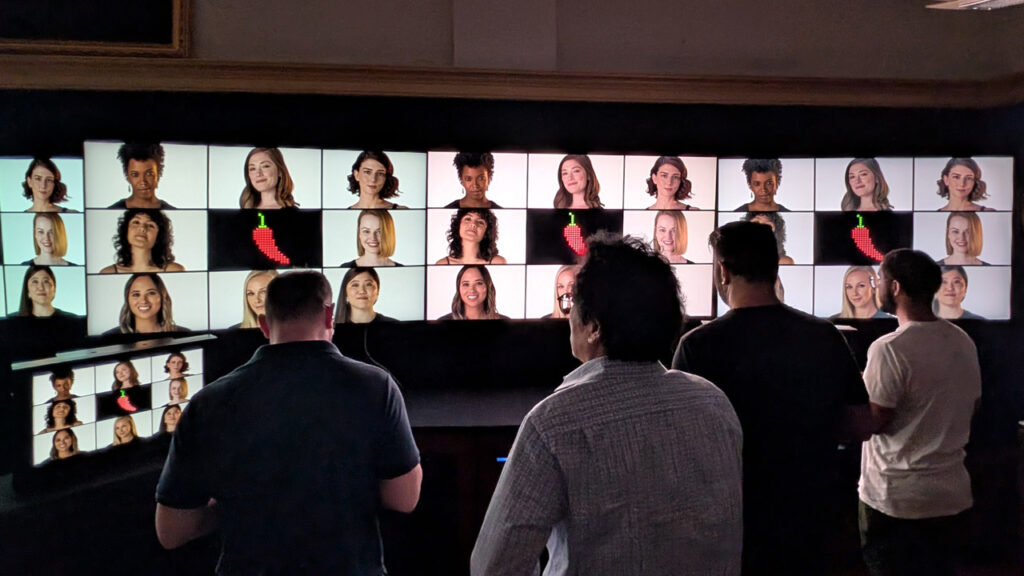
Then, in July, six of the year’s flagship TVs were put in the same room and judged side by side against professional mastering monitors. The OLEDs won. Not narrowly, and not on a technicality.
That is the state of play right now, and understanding why matters more than the brochure figures do, because the gap between what these two technologies claim on paper and what they deliver in a controlled room is where the whole decision actually sits.
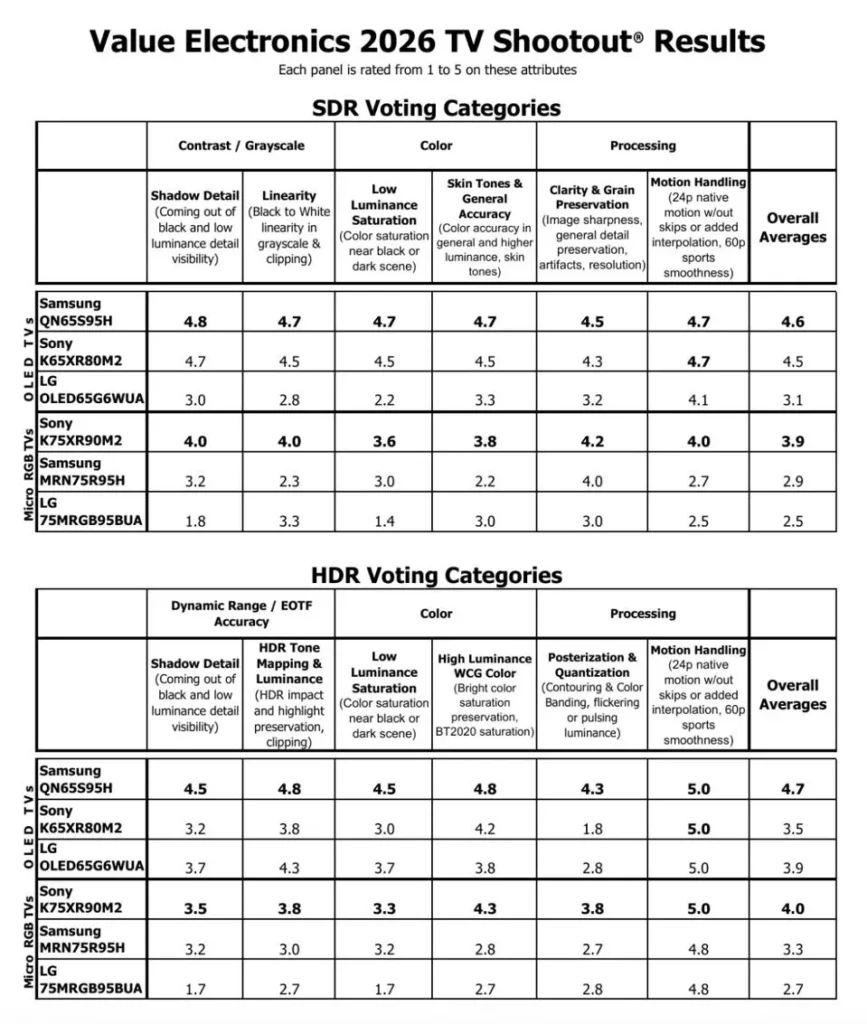
Photo: Value Electronics
RGB Mini LED vs OLED: the quick comparison
| RGB Mini LED | OLED | |
|---|---|---|
| How it makes light | LCD panel lit by independently controlled red, green and blue LEDs | Each pixel makes its own light |
| Black levels | Very good, but backlight zones still bleed | Perfect, pixel-level |
| Peak brightness | Higher – up to 5,000+ nits on the halo models | 2,700–3,000 nits measured on 2026 flagships |
| Colour volume | Wider at high brightness | Excellent, especially QD-OLED |
| Viewing angles | Better than typical LCD, still short of OLED | Best in class |
| Burn-in risk | None | Reduced, but not zero |
| Largest sizes | 115–116 inches | 97 inches |
| Best for | Bright rooms, big screens, sport and gaming HUDs | Dark rooms, films, contrast-first viewing |
What is RGB Mini LED?
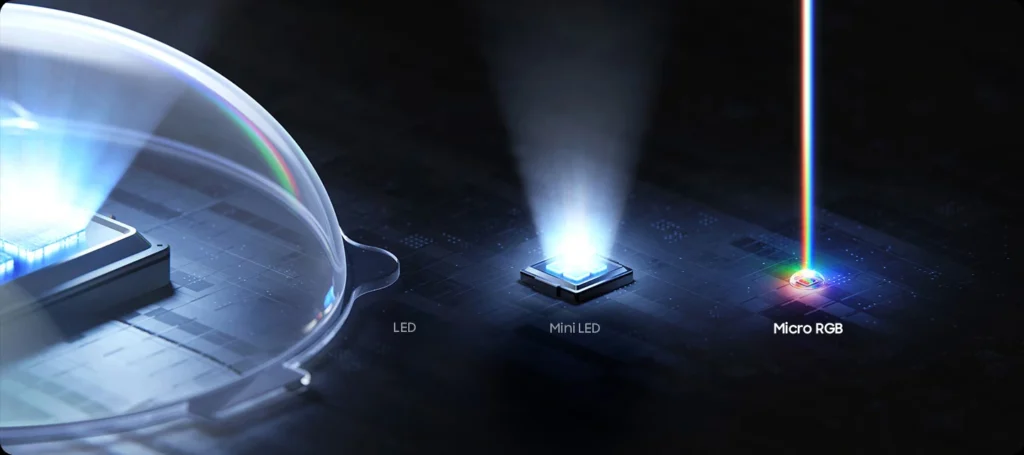
A conventional Mini LED TV uses a backlight of blue or white LEDs, then converts that light into red and green through a quantum dot or phosphor layer. RGB Mini LED skips the conversion step: the backlight itself contains separate red, green and blue emitters, controlled independently.
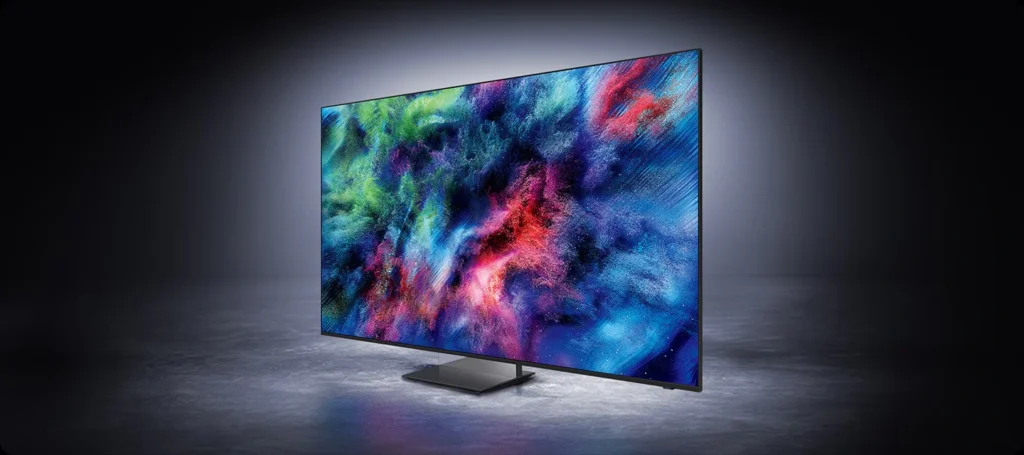
The result is more efficient, brighter and capable of covering more of the BT.2020 and DCI-P3 colour spaces. Every brand has its own name for it. Samsung calls its version ‘Micro RGB‘ on the grounds that its diodes measure under 100 microns, against the 100–400 microns typical of Mini LED. Sony calls its implementation ‘True RGB‘. Hisense has gone with ‘RGB Mini LED TriChroma’.
Underneath the branding, though, all of these sets have one thing in common: they are LCD televisions with a backlight behind them.
What is OLED?
OLED pixels are self-emissive. Each of the roughly 8.3 million pixels on a 4K panel produces its own light and switches fully off when the image calls for black. There is no backlight, no local dimming algorithm and no light leaking sideways into the pixels next door.
Functionally, an OLED TV has 8.3 million dimming zones. The best RGB Mini LED sets have a few thousand.
Black levels and contrast: OLED wins, and it isn’t close
This is the difference everything else flows from. No matter how many zones an RGB backlight has, a single zone is still lighting hundreds or thousands of pixels at once, which means the light going to a bright object and the light going to the darkness beside it are being controlled by the same physical emitter. Put a single bright star against a black sky and you get a faint halo. Put white subtitles on a dark scene and the area around them lifts.
Manufacturers have got very good at hiding this. More zones reduce blooming. Better optical layers tighten the light. Smarter algorithms respond faster. But it is all management of a problem OLED simply doesn’t have.
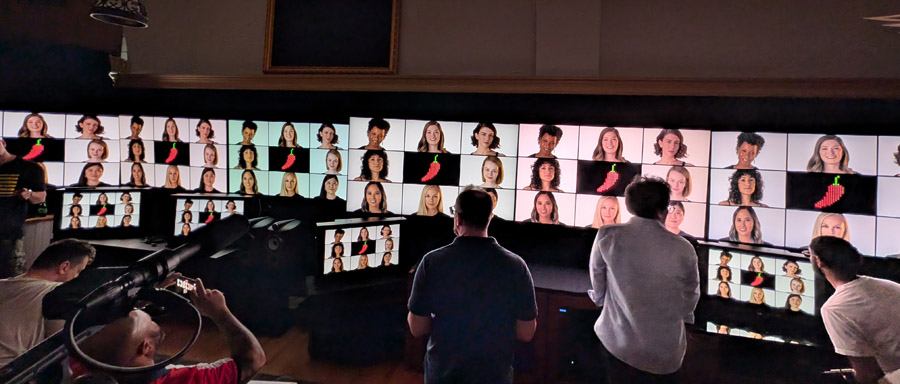
That was borne out at the 2026 TV Shootout, the 25th annual event run by Value Electronics in Scarsdale, New York, on 18 July. Six sets were calibrated by ISF calibrator DeWayne “D-Nice” Davis and judged against four Sony BVM-HX3110 mastering monitors – the same reference displays studios use to grade films. Reporting for ecoustics, judge Chris Boylan concluded that OLED retains significant advantages over even advanced RGB-backlit LCD on uniformity, black levels, contrast and colour saturation, and said he would personally take any of the three OLEDs over any of the three RGB sets.
Brightness: RGB Mini LED wins, but read the numbers properly
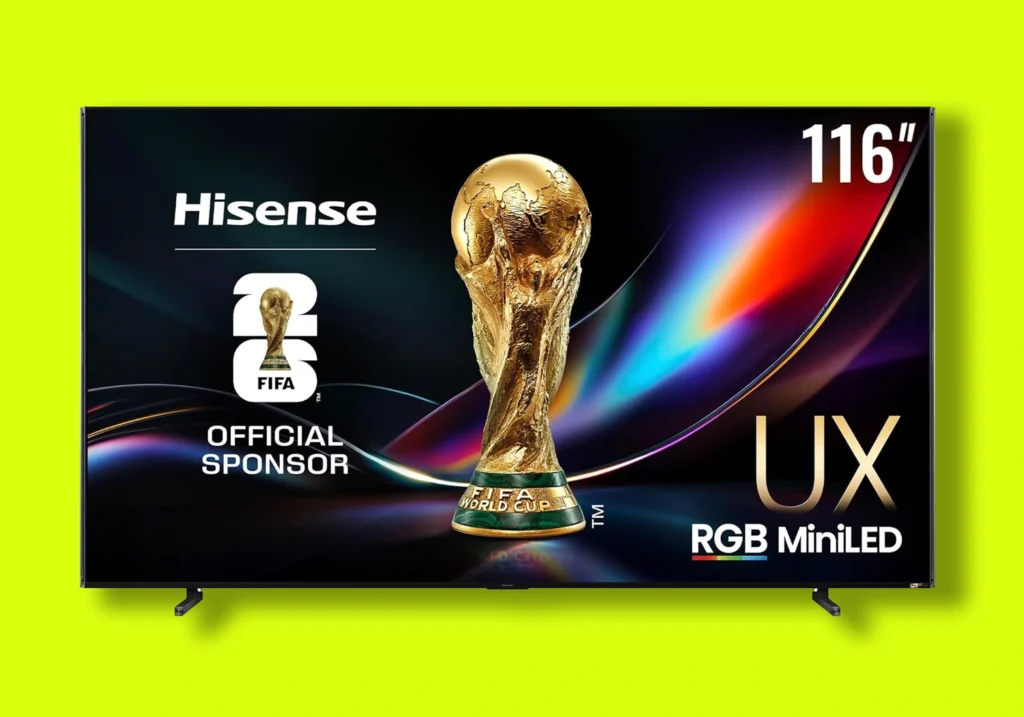
Brightness is where RGB Mini LED has a genuine, measurable lead. Hisense’s 116-inch 116UX pushed past 5,000 nits in Tom’s Guide testing, making it the brightest set that publication has measured. Sony targets around 4,000 nits for the Bravia 9 II.
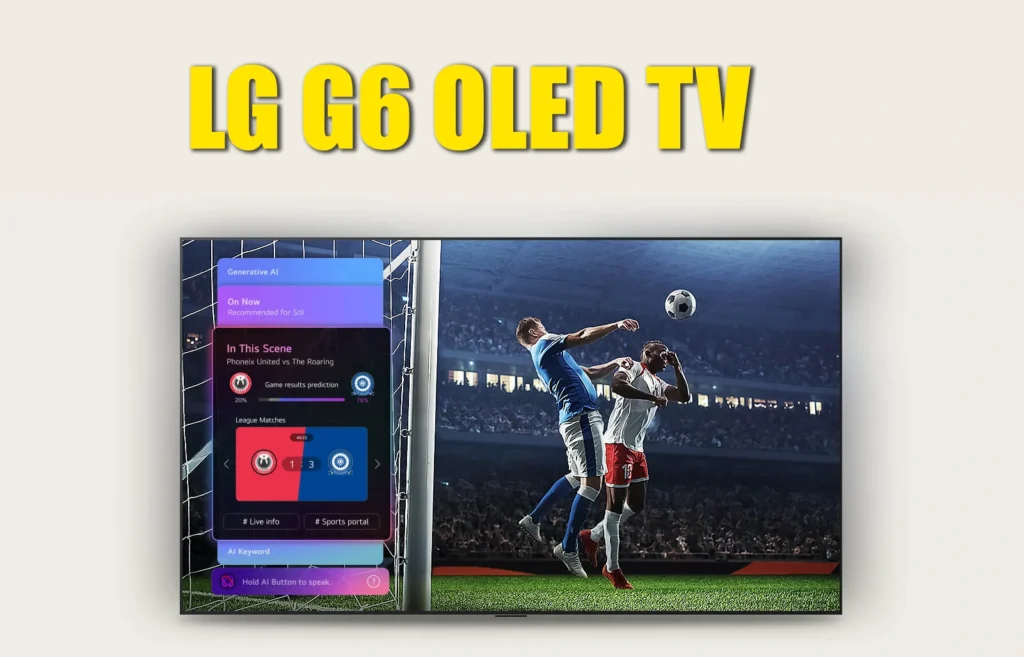
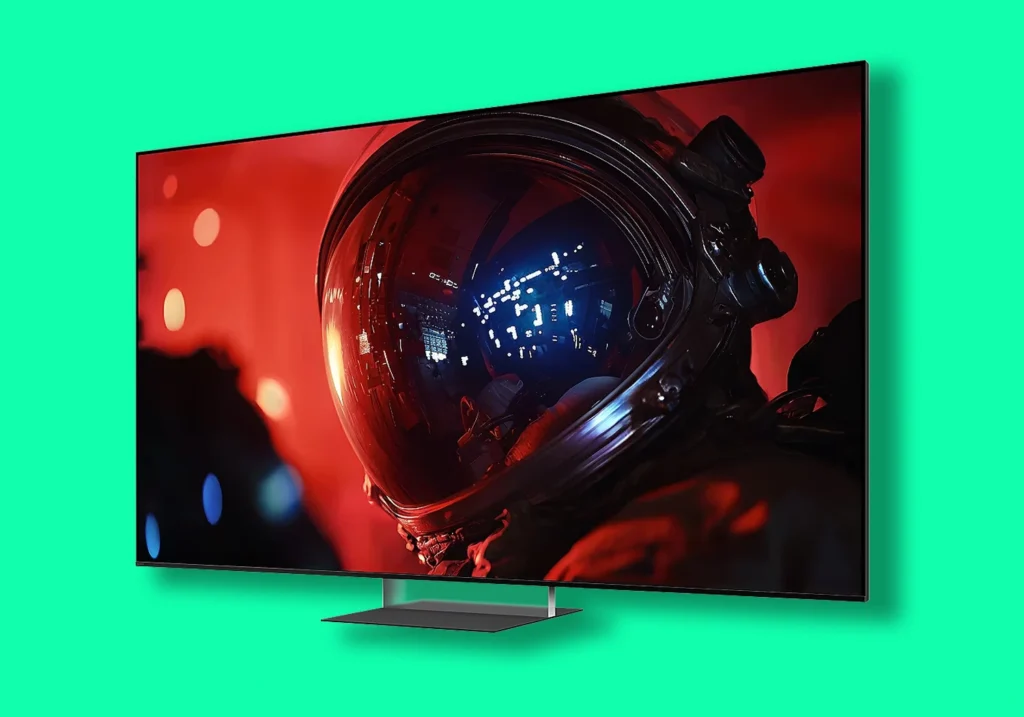
OLED has closed the gap more than most people realise, but not all the way. LG’s claim for the G6’s Primary RGB Tandem 2.0 panel is roughly 4,500 nits. When TechRadar measured it – 10% window, Filmmaker Mode – it recorded 3,004 nits. The Samsung S95H managed 2,739 nits on the same test.
That gap between the marketing figure and the measured one is the whole argument in miniature. On paper, RGB Mini LED looks like a rout. In a calibrated dark room with real content, the advantage narrows to something far less decisive than the spec sheets suggest.
But peak brightness on a 10% window is not the same thing as a picture that holds together, and the two get conflated constantly in the marketing for both technologies. A TV that throws 4,000 nits at a highlight while greying the black around it has traded the wrong thing away.
Colour
Removing the colour-conversion layer genuinely helps. RGB-backlit sets cover more of the wide colour gamuts used for HDR mastering, particularly at high brightness levels where OLED starts to run out of headroom.
On the OLED side, QD-OLED (Samsung S95H, Sony Bravia 8 II) reproduces a slightly wider gamut than W-OLED (LG G6), which is why the LG’s cooler whites and marginally muted SDR colours were flagged at the Shootout.
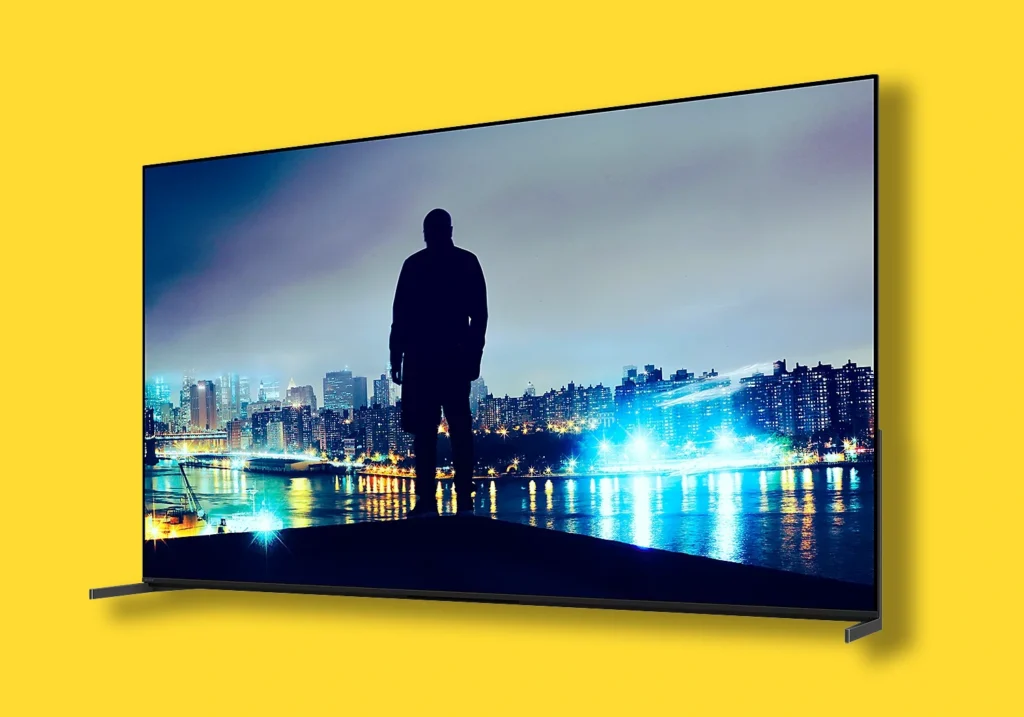
Processing matters as much as the panel here. And there was noticeably more variation between the three RGB sets than between the three OLEDs, which Boylan put down to how new the technology is – Sony and LG were fielding first-generation production models. Sony’s Bravia 9 II won the RGB category, and Sony being very good at video processing is not a new observation.
Viewing angles, gaming and burn-in
All three RGB sets at the Shootout held up better off-axis than typical LCD TVs. Still not as well as OLED, which loses almost nothing from the side.
For gaming, OLED’s near-instant pixel response remains the advantage, and LG’s four HDMI 2.1 sockets across the G6 and C6 continue to be the most complete package for anyone running a console and a PC. Sony has historically fitted only two, so check the spec sheet rather than assuming. Most 2026 flagships on both sides now support 4K at up to 165Hz.
Burn-in is the one genuine tick in RGB Mini LED’s column that no amount of OLED refinement removes, because it is a consequence of organic materials ageing rather than a flaw anyone can engineer away. Modern panels use pixel shifting, logo dimming and compensation cycles, and LG now backs the G6 with a five-year panel warranty. The risk is small and getting smaller. It isn’t zero, though, and if your TV displays a news ticker or a game HUD for eight hours a day, that is a real consideration rather than an internet myth.
Screen size and price: RGB Mini LED’s real win
OLED stops at 97 inches, and the 97-inch LG G6 costs $24,999. Above 83 inches, OLED effectively isn’t a practical option. RGB Mini LED runs to 115 inches (Samsung) and 116 inches (Hisense).
And the price story is moving fast, mostly in RGB Mini LED’s favour. The Hisense UR9 was announced in the US at $3,500 and is now $1,999.99 at Best Buy for the 65-inch. Hisense France has indicated 2026 RGB models starting at €1,499 for 55 inches. Against that, a 65-inch LG C6 OLED sits at £2,499.99 in the UK and ₹1,94,990 in India, with the flagship G6 at £2,999.99 / $3,399 / ₹2,38,990.
Of course, the picture is different in every region – the UR9 launched at £2,999 in the UK, where it competes directly with flagship OLED rather than undercutting it.
What the reviews say about the first mainstream RGB Mini LED TV
The Hisense UR9 is the set that brought RGB backlighting down to normal screen sizes and something approaching normal money, so it is the fairest test of where the technology actually is.
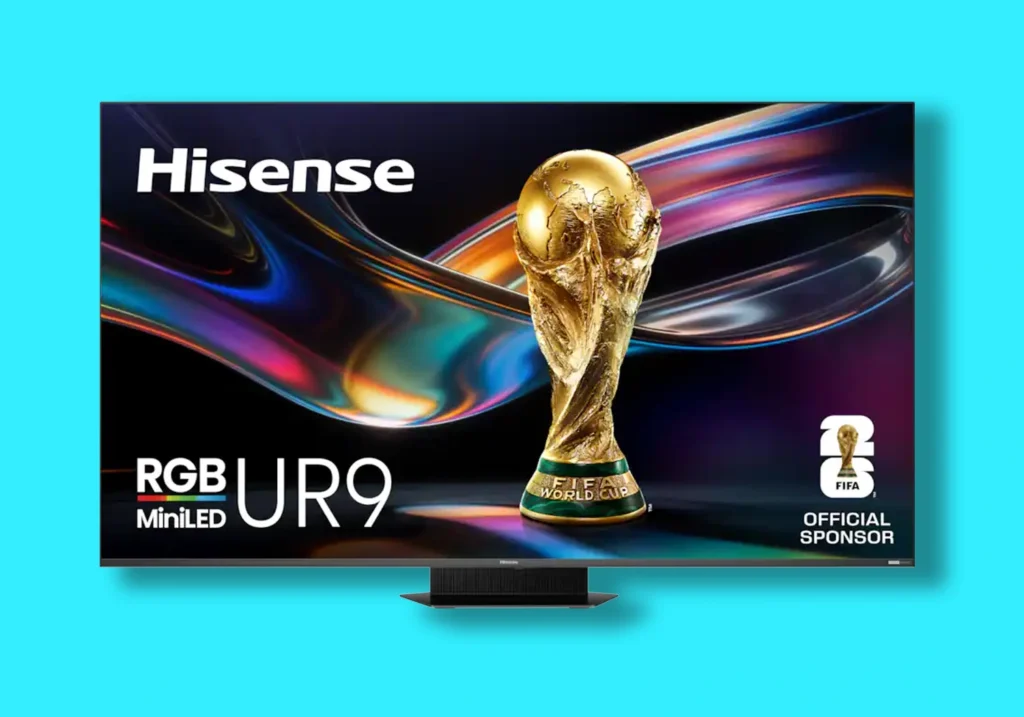
What Hi-Fi? called it impressive and a tantalising glimpse of the technology’s long-term potential, while concluding it falls a fair way short of a flagship OLED. Tom’s Guide found it excelled on brightness but was let down by inconsistent colour depth and balance, and struggled to justify the launch price. ecoustics rated it far more highly once the street price dropped.
Three reviewers, three testing setups, one verdict: promising, not finished.
Which should you buy?
Answer two questions honestly.
How bright is the room? If your TV faces windows and you watch mostly in daylight, RGB Mini LED is the easier recommendation. Its brightness headroom punches through ambient light in a way OLED still can’t quite match.
How big do you need to go? Above 83 inches, the decision is made for you.
If neither of those applies – if you watch films at night, in a room you can control, and 65 or 77 inches is enough – buy the OLED, at least for now. You will get better blacks, better uniformity, better viewing angles and an image that stops reminding you it is coming from a television.
Whichever you choose, pair it with a soundbar or a proper speaker system. No flat panel of any technology has solved sound.
Best models right now
OLED: Samsung S95H (winner of the 2026 TV Shootout, $3,399 for 65in), LG G6 (£2,999.99 / $3,399 / ₹2,38,990, brightest OLED LG has made, four HDMI 2.1), LG C6 for value (£2,499.99 / ₹1,94,990 at 65in).
RGB Mini LED: Sony Bravia 9 II (Shootout RGB category winner, $4,599 for 75in), Samsung R95H ‘Micro RGB’, Hisense UR9 (the value pick at $1,999.99 in the US, less compelling at £2,999 in the UK).
FAQs
Not for overall picture quality, not yet. It is better for peak brightness, bright rooms and screens above 83 inches.
Effectively yes. Samsung uses ‘Micro RGB’ because its diodes are smaller than 100 microns. The underlying approach – independently controlled red, green and blue backlight elements behind an LCD panel – is the same.
No. It is an LCD panel, so static content carries no permanent risk.
If you need a TV now and your room is dark, no. If you want a very large screen or you can wait, the second generation should be a meaningful step on, and prices are falling quickly.
OLED, on response time and motion clarity, with LG’s four HDMI 2.1 sockets the most complete specification. RGB Mini LED is the safer choice if you leave a HUD on screen for hours at a time.
The verdict
RGB Mini LED had everything going for it this year. New hardware from five brands, the biggest marketing push in the industry, a genuine brightness advantage and a real answer to OLED’s size ceiling. It arrived, and it is very good, and in several respects it is the most exciting thing to happen to LCD in a decade.
Then six flagships went into one room, and the OLEDs won anyway.
That will change. The technology is one generation old, the processing is still being learned, and competition of this kind is exactly what drives picture quality forward. The OLED killer will arrive one day.
It didn’t arrive in 2026.