

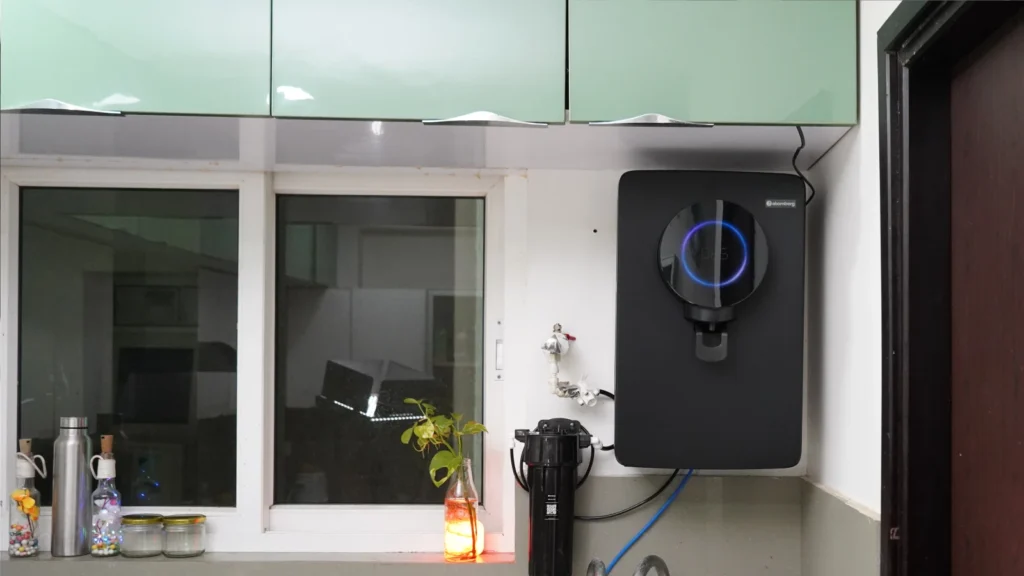
The Atomberg Intellon is still the cheapest water purifier to keep running that we have tested, at Rs 4,010 in parts every two years against roughly Rs 5,000 a year for a Kent, Aquaguard or Pureit annual contract. The water is good, the app is genuinely useful, and Atomberg publishes its filter prices instead of sending a technician to quote them at you in your kitchen.
What has changed over a year of use is our confidence in three of the features it advertises, and that has taken our score from 9.0 down to 7.5.
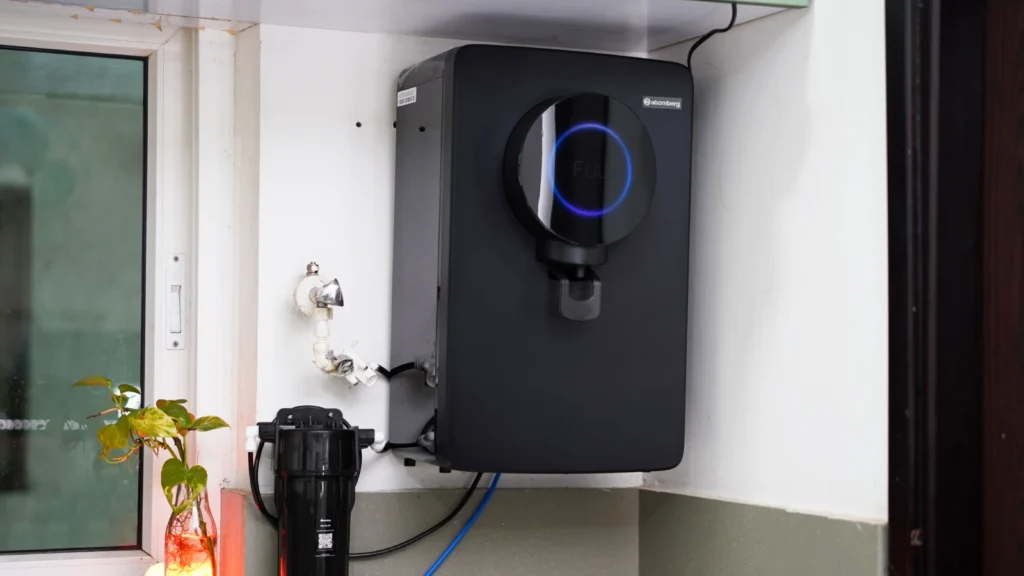
What the Atomberg Intellon is
The Atomberg Intellon is an 8 litre RO purifier with seven purification stages, which is fewer than the ten that Kent and Urban Company advertise. But stage counts are mostly a marketing exercise, and what matters is what each stage actually does.
Water passes through a pre-filter, an inline sediment filter and a pre-carbon filter, then a membrane protector, then the RO membrane itself, then a UF membrane and UV lamp, and finally an alkaliser cartridge that puts calcium and magnesium back into water the RO membrane has just stripped out of it.
It’s rated for input water up to 1,500 ppm TDS (a figure worth remembering, because it matters later), draws 50 W while running and 5 W sitting idle, weighs 8.5 kg, measures 350 x 280 x 558 mm (so it needs proper counter space) and dispenses up to 25 litres an hour.
Atomberg sells it at Rs 18,999 and a card offer brings it to Rs 16,000 or Rs 17,000 most weeks of the year, without waiting for a sale.
Design and build
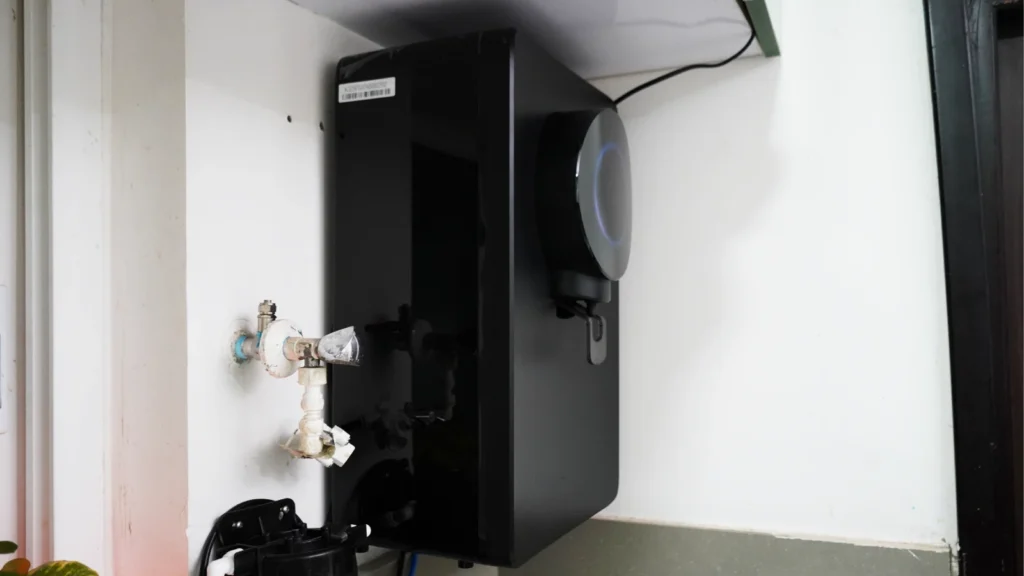
The Intellon is plain rather than handsome. The body and the storage tank are food grade ABS plastic rather than stainless steel. This is the one place where the price shows. That’s safe, and it’s what most purifiers in this bracket use. But steel would buy more confidence at this money, and the Native M3 Pro does offer it.
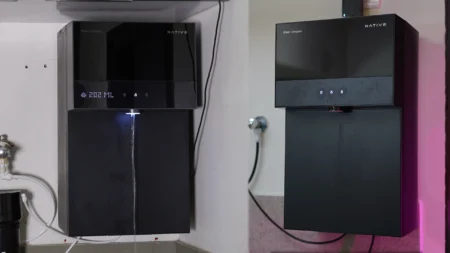
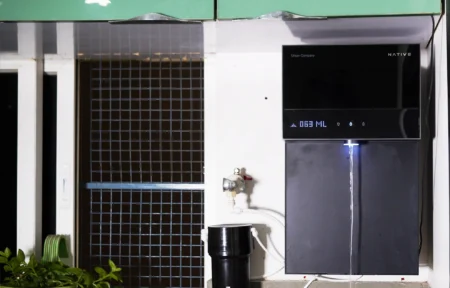
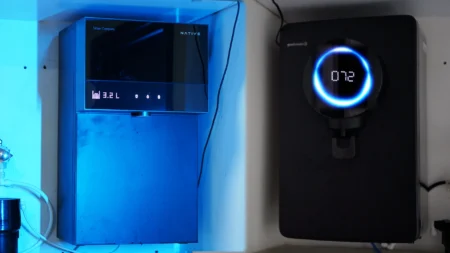
The front panel is a crisp digital readout rather than a touchscreen, showing input and output TDS, tank level and error codes, and I can read it from across the kitchen. No touchscreen is a good call at this price – touch panels on cheap appliances age badly, and a printed legend with a real display behind it will still be legible in five years when a capacitive film has started ignoring the bottom third of itself.
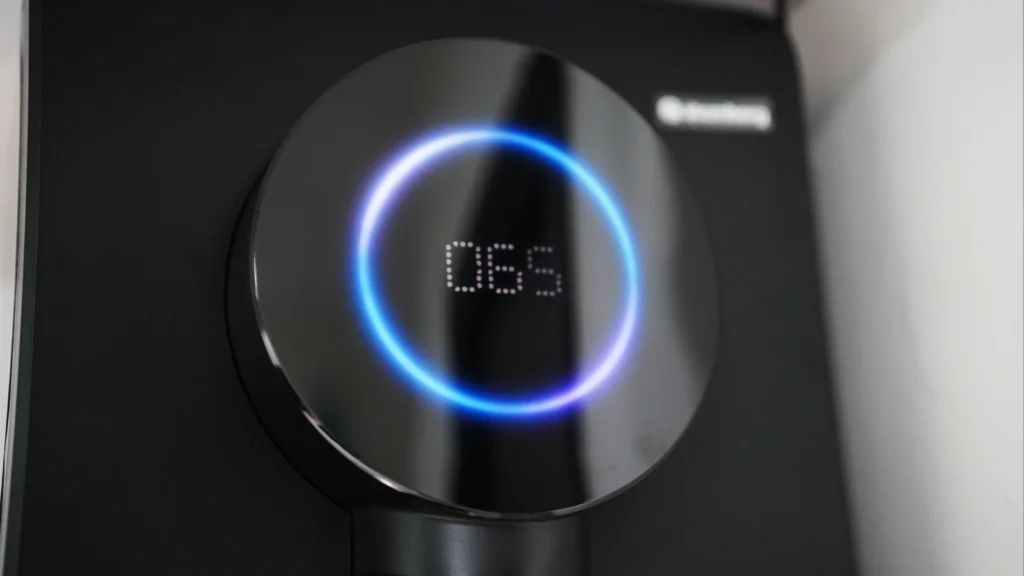
What it doesn’t have is a bottle tray. You hold the glass while it fills. That’s a small thing, and it gets old, and both the Native M2 Pro and the older Native models include one.
Setup runs over Wi-Fi and the Intellon won’t find your network by itself, so you pick the 2.4GHz band by hand during installation, after which the Atomberg Home app handles filter health, TDS history and service bookings.
Atomberg purification modes, explained
The modes are the part of the Intellon that separates it from every other purifier at the price, and it’s also where a first-time buyer is most likely to get lost, so here is what each mode actually does.
1. Adaptive Flow Mode
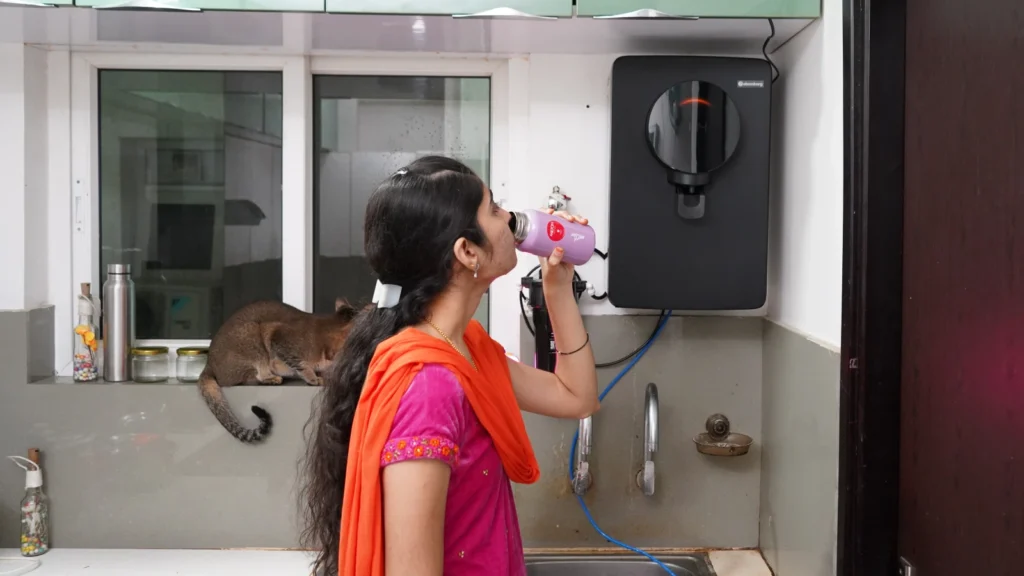
Adaptive Flow is the headline feature and the reason Atomberg calls this an adaptive purifier.
An RO membrane strips dissolved salts out of water by forcing it through a very fine film under pressure, which wears the membrane out over time and sends roughly a litre down the drain for every litre you actually drink. On water that’s already soft, all of that work is unnecessary. Every bit of it.
So the Intellon reads the incoming TDS, and if it’s below 250 ppm it skips the RO membrane entirely and sends the water through the remaining stages instead (UF, UV and the alkaliser all still run). Less wear, less waste, and the minerals that were already in your water stay in it (which is the point most people miss about RO).
It is a genuinely good idea, and I have not seen another purifier at this price do it.
The problem with Adaptive Flow
Adaptive Flow is the feature the whole Intellon is sold on, and in a large share of the country the Atomberg app will not let you turn it on.
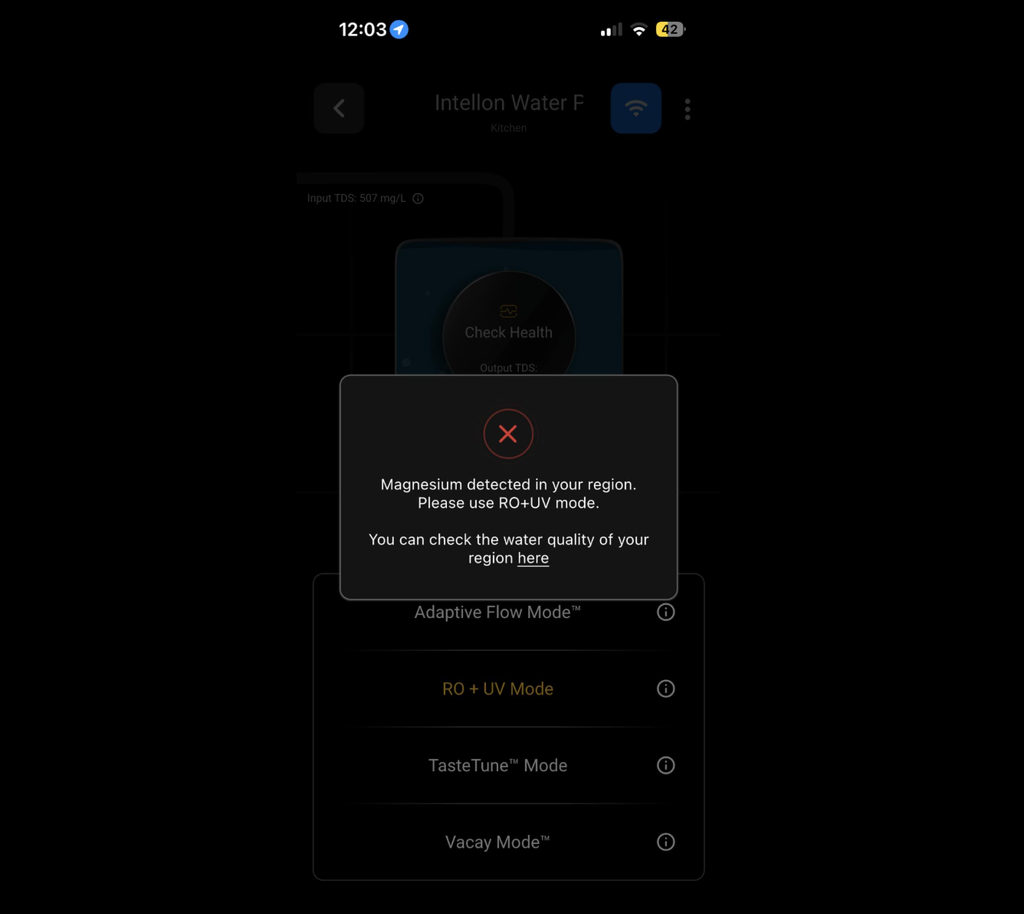
Open the mode list and you may find Adaptive Flow greyed out leaving RO + UV as the only mode you can select. The message reads: “Magnesium detected in your region. Please use RO+UV mode,” with a link to check your regional water quality. It is done by pin code – against contamination data Atomberg holds for your area, and has not published anywhere.
Is blocking it the right call? Where there’s real contamination, yes, and I’d defend Atomberg on it – a machine that skipped the RO membrane on fluoride-heavy groundwater would be genuinely dangerous.
But the block goes on the region rather than on the water actually running through the machine, so a soft municipal supply in a flagged pin code stays shut out whatever the inlet sensor reads. Owners on corporation water at around 300 ppm, softener fitted, have found every mode locked.
The Central Ground Water Board flagged 644 of the 755 districts it monitored for at least one contaminant above the BIS limit across its 2024 and 2025 reports, which is 85 per cent of everything it looked at.
So check what your own district is flagged for before you buy, because if it’s on the list you’re paying for a four-mode purifier and getting a one-mode purifier.
2. RO + UV Mode
RO + UV is the Intellon’s conventional mode, and it runs the full chain including the RO membrane.
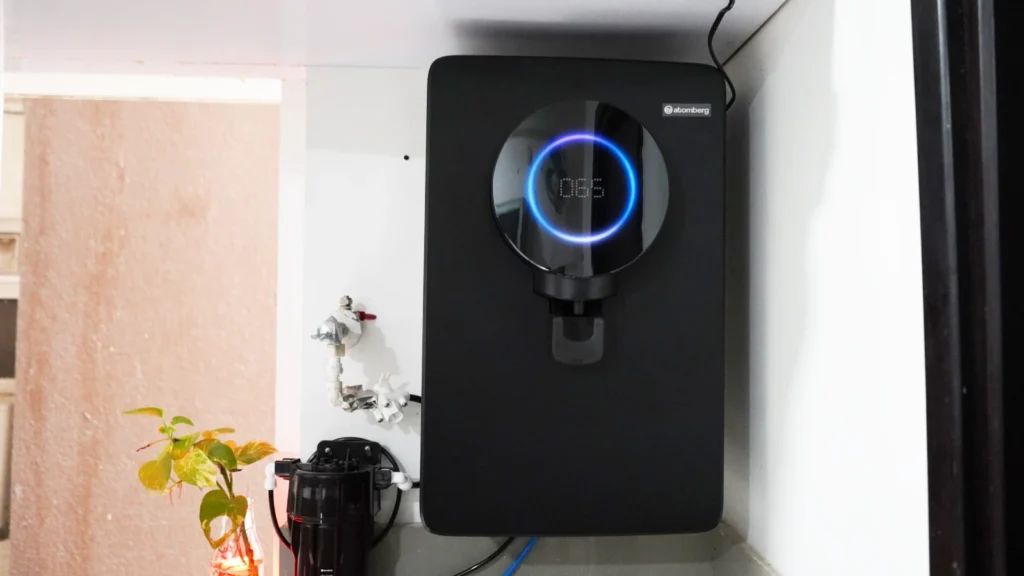
Use it when your supply is above roughly 300 ppm. Use it regardless of TDS if there’s any chance of chemical contamination, because a TDS meter measures how much is dissolved in your water rather than what is dissolved in it – and that distinction is the single most useful thing anyone can tell you about buying a purifier. Fluoride, arsenic, nitrate and lead don’t move the TDS number at all, so water can read a comfortable 180 ppm and still be genuinely unsafe to drink without an RO membrane in the way.
3. TasteTune Mode
TasteTune lets you pick the TDS of the water coming out of the Intellon, which almost nothing else at this price will do.
You choose a band rather than a number, because the input moves a little with the season, and the output moves with it (no purifier can hold an exact figure), and the three options are 50 to 100, 75 to 125 and 100 to 150 ppm. The alkaliser cartridge doses calcium and magnesium back in to hit the band you picked.
If you want the short version, ours has been left on 75 to 125 throughout. The water is clean and faintly sweet, close to bottled, and I have no complaints about it at all.
4. Vacay Mode
Vacay Mode has the Intellon run an automatic flush every 48 hours while you’re away, which stops water standing in the filters and going stale, and it drops the machine’s draw to 1 W (down from the 5 W it idles at normally).
It’s a small feature that most brands don’t bother with. If you travel often, it saves you coming home to a purifier that needs running off for five minutes before the water tastes right again.
The TDS reading won’t match your meter
Hold a handheld TDS meter under the Intellon’s tap and the two numbers won’t agree, and that’s deliberate rather than a fault. Atomberg explains it inside the app, on a screen most owners will never open.
Intellon’s sensors are calibrated against the 442 solution, a mix of 40 percent sodium bicarbonate, 40 percent sodium sulphate and 20 percent sodium chloride, chosen because it resembles what’s actually dissolved in drinking water. Most handheld meters are calibrated against plain sodium chloride instead, which suits brackish and sea water better than it suits your tap. Atomberg’s own wording is that a 442-calibrated sensor “typically shows 40% higher TDS readings” than an NaCl meter.
The science is defensible, and I’m not going to call it wrong.
But what it does to the features is another matter, water in your tds meter reads at 250 arrives at the purifier as 320 and the adaptive mode stays shut even where it hasn’t been locked by pin code.
Ours ran 20 to 25 ppm above the handheld meter at normal output levels, which is roughly what 40 percent comes to down there. I checked it more than once.
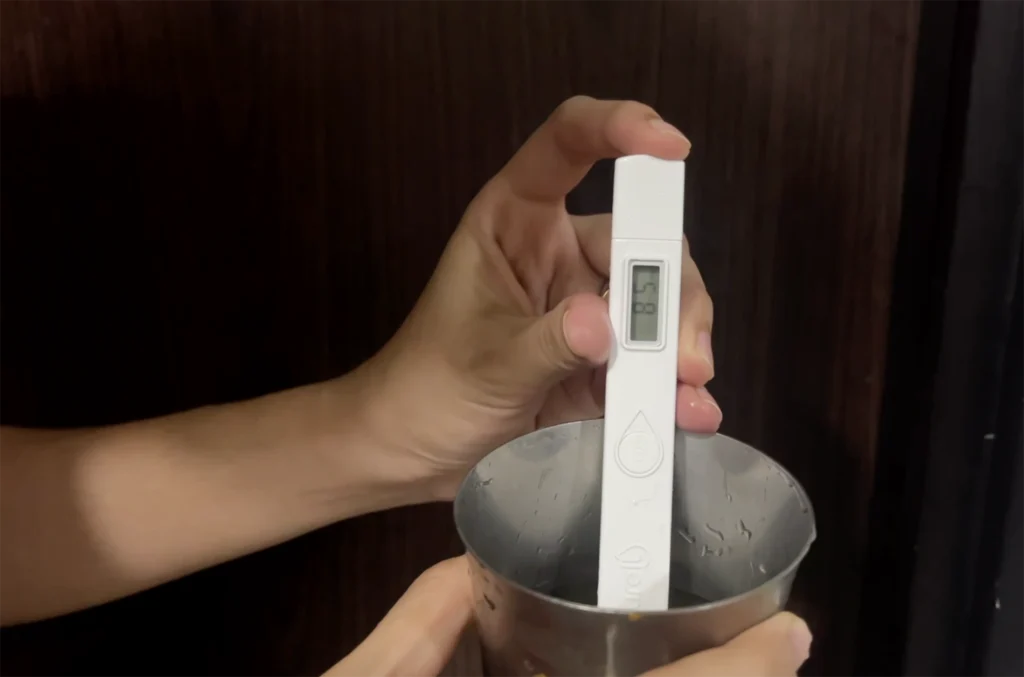
None of this affects the water. It affects whether you can check the machine with the one tool you already own, which I’d argue matters on a purifier sold on its sensors.
Filter life, and what actually changes it
Filter life on the Intellon isn’t one number; Atomberg is more honest about this than most brands are.
The published figures scale with how hard your water is, which makes sense, because an RO membrane working on 1,500 ppm borewell water wears out faster than one sipping municipal supply at 200 ppm.
| Water type | Typical source | RO membrane life | Other filters |
|---|---|---|---|
| Soft | Municipal supply, TDS under 300 ppm | ~20,000 litres + | ~15,000 litres |
| Moderate | Borewell or tanker, TDS ~750 ppm | ~15,000 litres | ~15,000 litres |
| Hard | Borewell, TDS ~1500 ppm | ~12,000 litres | ~12,000 litres |
Atomberg’s own footnote is worth quoting, because it’s the sort of thing brands normally bury: “Filter life is impacted by your water’s TDS, turbidity & hardness. The better the input, the longer your filters last.”
The manual that ships with the machine states a filter life of up to two years, tested for up to 12,000 litres, which is the hard water case at the top of the machine’s 1,500 ppm range (so it’s the floor, not the average).
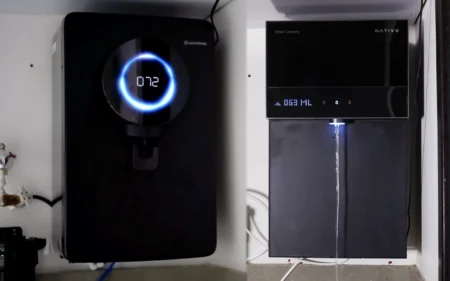
Worth setting against the Native M3 and M3 Pro here, which are rated at a flat 18,000 litres or three years and take input water up to 2,000 ppm.
And the other half of Atomberg’s argument is that you don’t replace everything at once, which brings us neatly to what it costs.
Maintenance and service costs
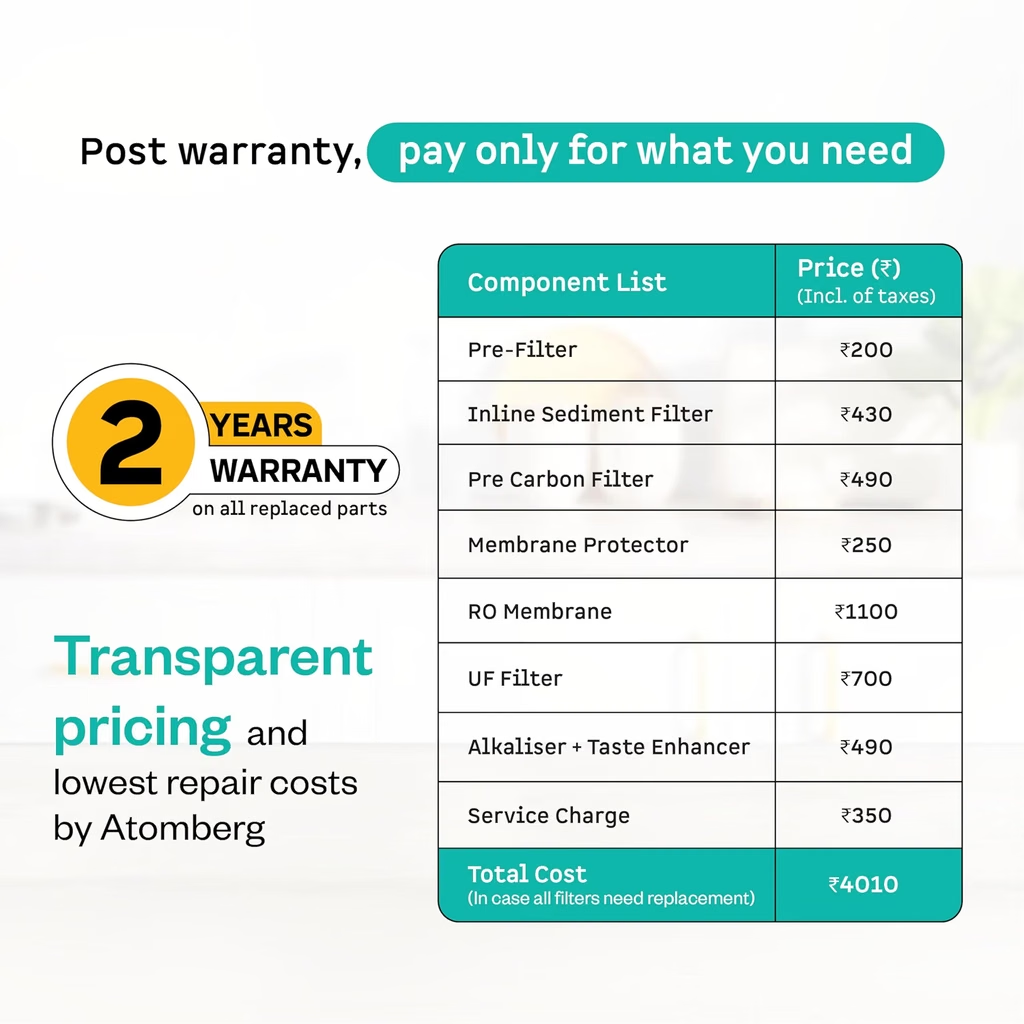
Rs 4,010 including taxes replaces every filter in the Intellon plus the service call, and each replaced part then carries a fresh two year warranty of its own.
The RO membrane is the expensive one at Rs 1,100. After that it’s the UF filter at Rs 700, the pre-carbon and the alkaliser at Rs 490 apiece, the inline sediment filter at Rs 430, the membrane protector at Rs 250 and the pre-filter at Rs 200, with a Rs 350 service charge on top.
There’s no AMC, no annual contract and nothing to renew.
Compare that with the rest of the category, where a Kent, Aquaguard or Pureit annual maintenance contract runs around Rs 5,000 a year and bundles filters you may not need with service visits you may not use. Two years of owning an Intellon costs roughly what one year of those costs, and it’s the single strongest argument for this machine.
The first two years are covered anyway, with all filters, membranes and electrical components included along with the service visit itself.
Can you trust the filter health readout?
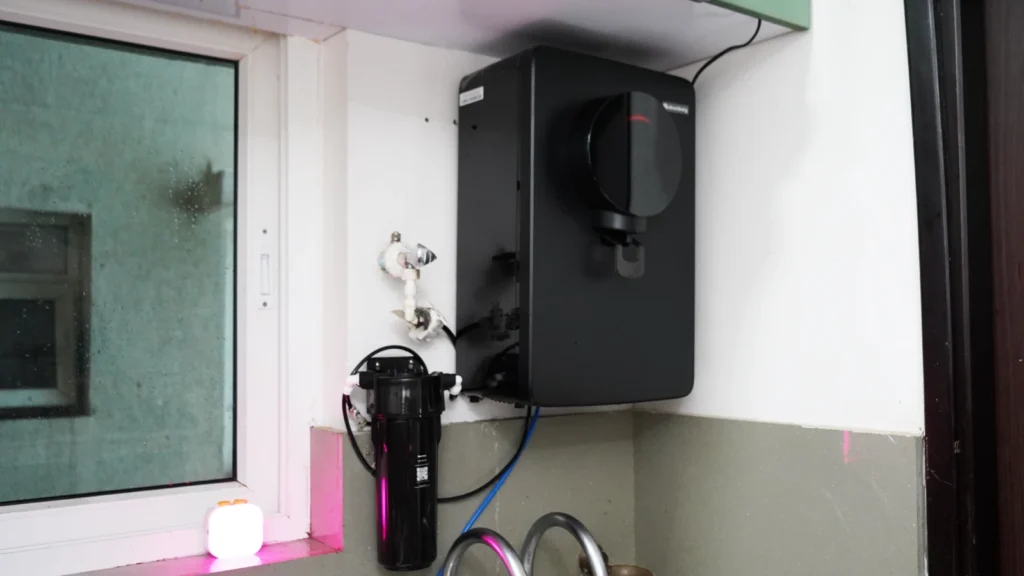
Not really, no. The Intellon’s filter health figure is the finding that surprised me most, and I went looking for it deliberately. The app reports filter health as a percentage, which reads like a measurement and isn’t one.
We disconnected a pre-filter entirely, left it sitting on a shelf, and carried on using the machine as normal for six months. The app still reported 90 percent health.
In fairness to Atomberg, nobody can judge a spent membrane from outside its housing, so every brand calculates rather than measures, and I’d say the same of all of them. Urban Company’s Native purifiers do the same thing, though they at least publish what feeds the sum: pump load, tank fill speed, inlet pressure, input TDS and output TDS.
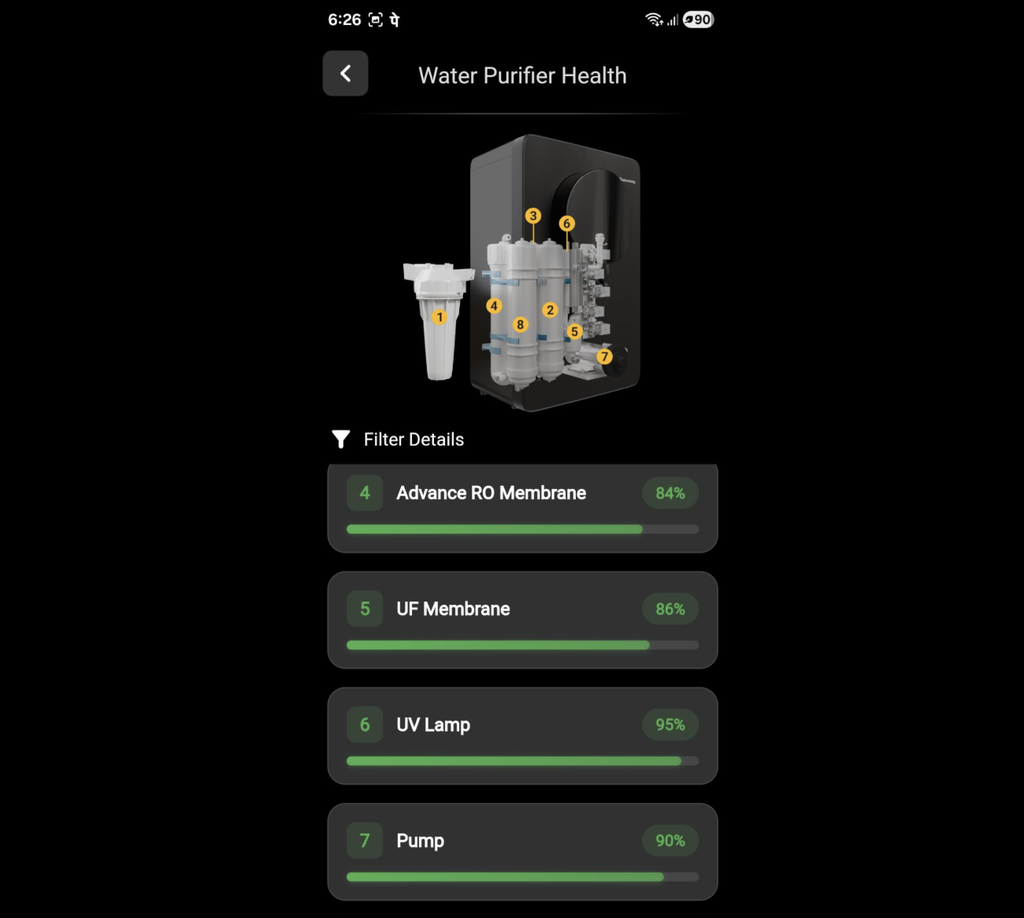
Atomberg hasn’t said what the Intellon’s calculation uses – and a missing filter clearly isn’t part of it.
Treat the percentage as a service reminder rather than a diagnosis, and change filters on taste and on how your water is behaving.
Water wastage and efficiency
The Intellon sends roughly a litre to drain for every litre it purifies, which is ordinary for RO and no better than it was a year ago.
Every RO purifier we’ve tested does much the same. All of them get worse as the input TDS climbs, too, because harder water means the membrane has to reject more of what goes in to produce the same litre of drinkable water at the other end, which is a physical limit rather than a design failure anyone could engineer their way past. The Native M3 Pro manages about 0.7 litres per litre on soft water, which is the best we’ve measured, and it comes level with everything else on hard borewell supply.
If your district allows it, Adaptive Flow is the Intellon’s answer to this, since skipping RO on soft water skips the waste entirely, and it’s a good answer in the districts where you’re allowed to use it.
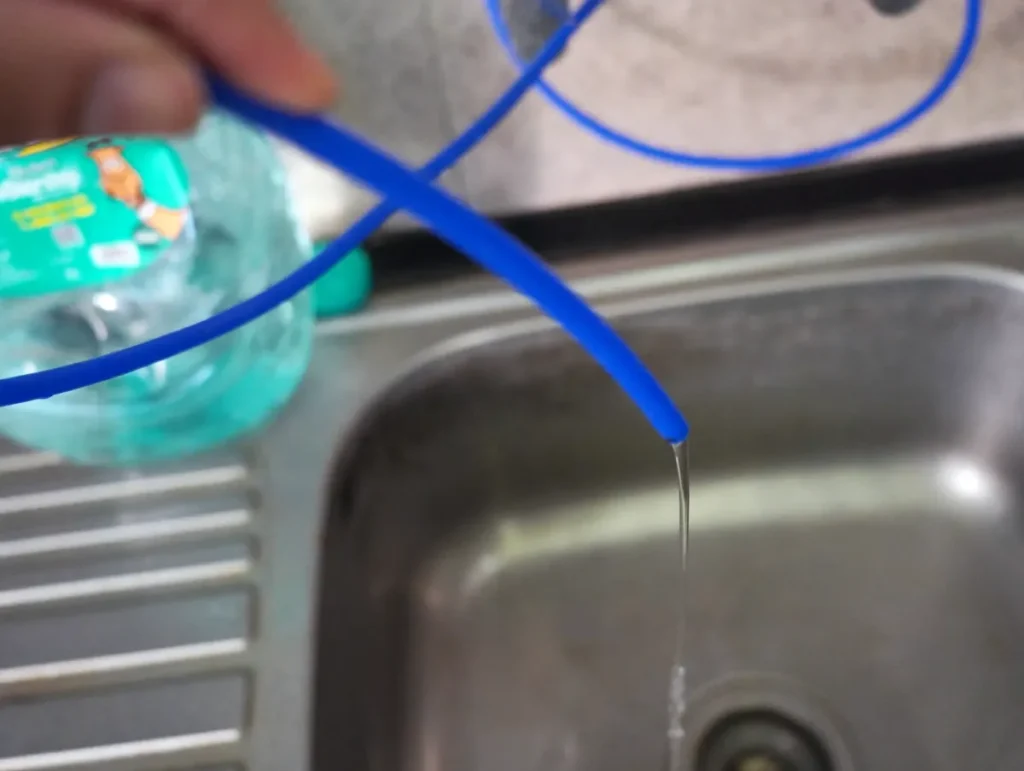
Keep a 20 litre can under the reject line either way. That water is fine for floors, bathrooms and plants.
Water taste and mineral output
The Intellon’s water tastes the same as it did on day one. Taste is usually the first thing to go on a purifier as the mineral cartridge ages, so that’s worth saying plainly.
The alkaliser puts calcium and magnesium back after the RO membrane has taken them out, and on the 75 to 125 ppm TasteTune setting the result is clean and slightly sweet (closer to bottled than to tap).
The white particle problem
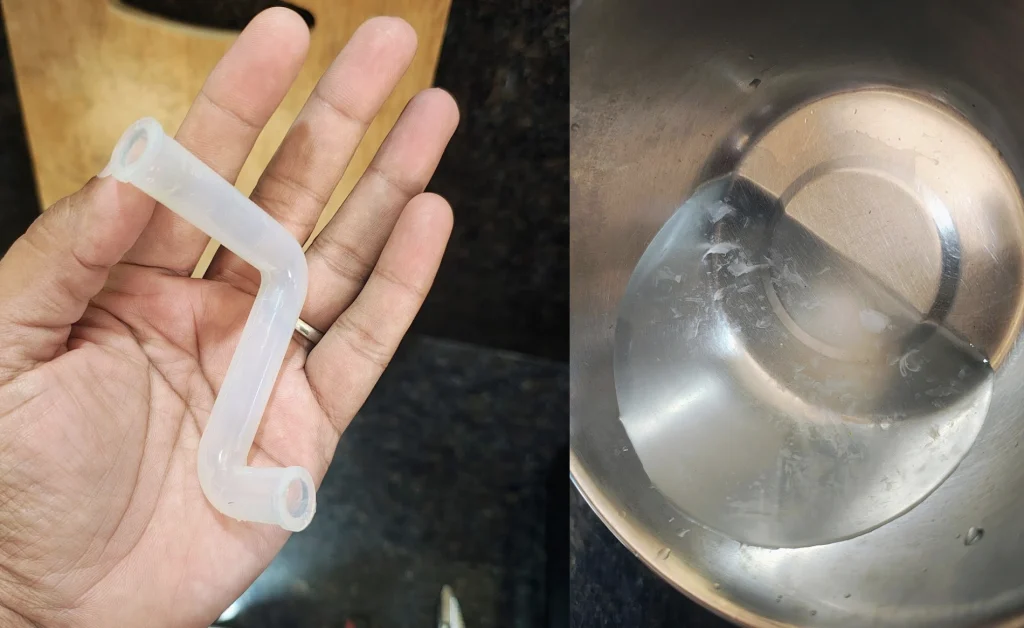
Two readers have written to us about white silicone flakes appearing in water dispensed by the Intellon, and around ten Amazon reviews describe the same fault, few of them posted as recently as this September.
Ours has never done it in a year of use.
I want to be careful here, because the sample is small and the accounts are not ours.
We found the reports follow one pattern closely enough that the technicians clearly recognise it: white transparent particles come through in the dispensed water, a technician visits and replaces a small silicone pipe.
Take that as reported rather than tested, because two emails and ten reviews are not a failure rate, and nobody writes in to say their purifier worked. And every one of those accounts described Atomberg’s service response as fast. Nobody was complaining about the technician.
It’s still the first thing I’d raise with a dealer before handing over any money.
Service and support
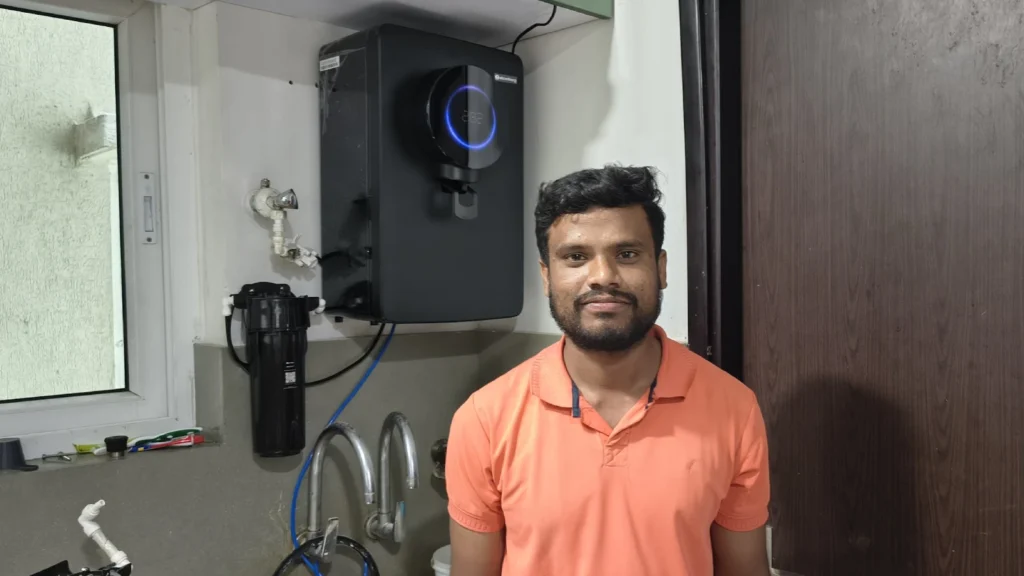
Atomberg’s service is good where it exists and absent where it doesn’t, and settling which of those applies to you is the single most important thing to do before ordering.
The company runs city-based dealerships staffed by its own trained technicians rather than farming the work out to aggregators, which is a better model than most of the category uses.
Install the Atomberg Home app, put your pin code to their support team, and ask a shop locally who actually turns up. Do the same with Urban Company’s app if you’re weighing the Native models, because their coverage thins outside the larger cities in much the same way.
One practical note: if your inlet pressure is below 10 psi the Intellon needs a booster pump.
Pros and cons
A year with the Atomberg Intellon, boiled down.
What we like
- Cheapest to keep running of anything we’ve tested, at Rs 4,010 in parts every two years
- Filter Prices published up front, itemised, with no AMC and no contract
- Replaced parts carry a fresh two year warranty
- Adaptive Flow is a genuinely clever idea where you’re allowed to use it
- TasteTune gives real control over output TDS, which nothing else at this price offers
- Vacay Mode keeps filters fresh while you’re away
- Filter life figures published honestly, scaled by water hardness
What could be better
- Adaptive Flow locked by pin code across much of the country
- Filter health reads 90 percent with a filter physically removed
- TDS display runs about 40 percent above a handheld meter, which most owners won’t know
- Recurring silicone pipe fault in reader reports
- ABS plastic tank rather than stainless at this money
- No bottle tray
- Wastes about a litre for every litre purified
Final verdict
The Atomberg Intellon is a good purifier that costs less to keep alive than anything else we’ve tested, and it’s no longer quite the machine we reviewed a year ago.
Nothing has gone wrong with the water, the taste or the running costs, all of which have held up exactly as they did on day one. What’s dropped our score to 7.5 is that three of the features the machine is sold on don’t behave the way a buyer would reasonably expect: the headline adaptive mode can be switched off remotely by pin code, the filter health figure isn’t measuring anything, and the TDS display speaks a different dialect to the meter in your drawer.
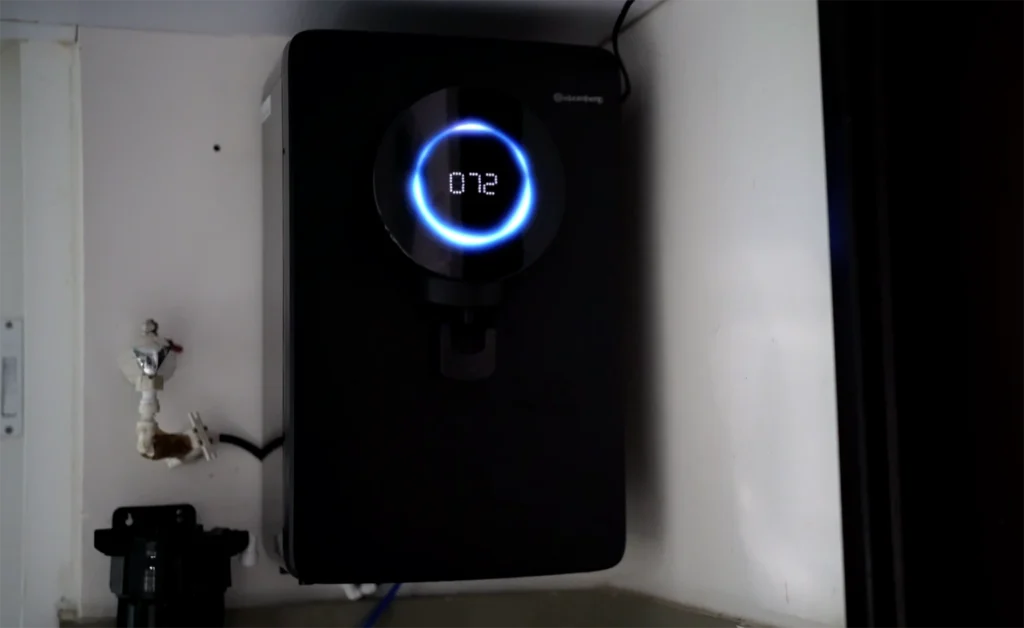
So who should buy one? If your district isn’t flagged and your supply genuinely sits low, you’ll get the purifier Atomberg advertises, and at Rs 16,000 to Rs 17,000 I’d find it very hard to beat.
If it is flagged, then as I read it you’re paying an adaptive premium for a machine that will only ever run RO + UV, and at that point the Native M3 Pro’s longer filter life and higher TDS ceiling are the better use of the money.
Either way it beats anything sitting on a Rs 5,000 annual contract, which is still most of what’s on the shelf.
Frequently asked questions
Adaptive Flow lets the Intellon skip its RO membrane when incoming water measures below 250 ppm, sending it through the other stages instead. That saves membrane wear and reject water on supplies that were already soft.
Atomberg app blocks it by pin code where contamination is on record, showing a message such as “Magnesium detected in your region. Please use RO+UV mode.”
Atomberg calibrates the Intellon’s sensors with the 442 solution while most handheld meters use sodium chloride. Atomberg states a 442-calibrated sensor reads about 40 percent higher. Neither number is wrong, they are different scales.
Rs 4,010 including taxes and the Rs 350 service charge, if every Atomberg Intellon filter needs replacing at once. Replaced parts carry a fresh two year warranty, and there is no AMC, so you pay only for what failed.
It depends on your water. Atomberg publishes around 20,000 litres for the RO membrane on municipal supply under 300 ppm, around 15,000 litres at 750 ppm, and around 12,000 litres on hard borewell water at 1,500 ppm.
The Atomberg Intellon is the cheapest purifier to keep running that we have tested, and its water is as good as it was on day one. Three advertised features don't hold up, and the app is where all three failures sit.
- Design
- Purification
- Water Taste
- Maintenance
- Service
- Water Wastage
- Value For Money
- App and Smart Features

5 Comments
the dispensing tap quality is very cheap and I don’t think it will work not more than 2 to 3 months. even the technician was not aware of the dispensing tap cosy which should I should bear after two years. you have not even mentioned regarding the tap quality. I don’t think this is a genuine review.
We haven’t faced any problems with the tap.. but the design can be improved..
Connecting app to purifier via Bluetooth and without WiFi allows choosing adaptive mode on the app. But if incoming water quality is indeed hazardous, RO+UV mode is safer and necessary, too.
What about spare part cost like electricals motor pump,etc. Other than filters after two years of warranty.
What would be the cost in replacing them ?
In native AMC covers all parts right.
Yes, in Native AMC all parts are covered.. even in Atomberg, for the first two years, you get warranty on all parts..