

This calculator should help you determine your average monthly and annual consumption
The major concern that people have when purchasing an Air Conditioner is that they do not know the amount of power it consumes. So, they are unaware of how much it affects their electricity bill. Our AC power consumption calculator makes it easy. Furthermore, it gives you the following information within no time.
- Daily units consumption by the AC in kWh (units)
- Monthly consumption in kWh (units)
- Annual consumption in kWh (units)
- Monthly electricity bill amount
- Annual electricity bill amount
All you enter are the following data.
- ISEER Rating
- Electricity Tariff
- AC Type
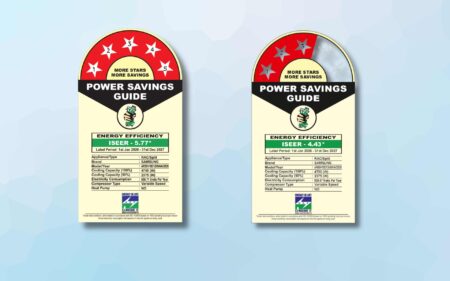
If you are worried as to where to find this data, it should not be an issue. The ISEER Rating and cooling capacity are readily available on the BEE Star label of your AC.

The electricity tariff varies from one city to another. You will get this amount on your electric service provider’s website.
Advantages of using our AC Power Consumption Calculator
- Our calculator is the most accurate of all calculators present on the internet. It gives accurate results of annual energy consumption and tallies with the BEE data provided on the Star Rating label.
- You can calculate your daily, monthly, and annual units consumption. Besides, you can also estimate your monthly and annual electricity bills (for the AC consumption alone).
- This calculator works with inverter, non-inverter, Split and window ACs.
- It works with all currencies.
Similar to the BEE calculation, our calculator also makes some assumptions
Your electricity consumption depends on the duration for which you run the AC in a day. Therefore, depending on your requirements, it will vary daily. Besides, you might not use ACs in winter.
On the other hand, your AC consumption could be higher in summer. Hence, BEE assumes that the average consumption is around 1600 hours a year. That roughly translates to an average of four and a half hours daily (4.38 hours). Our calculator works on the same assumption.
Similarly, inverter ACs do not run at full capacity all the time. Therefore, you find manufacturers displaying the cooling capacity of Inverter ACs at 100% and 50%. The cooling capacity should be somewhere between these two figures.

BEE considers the average cooling capacity to be approximately 77.46% to calculate the ISEER. Accordingly, we consider the ISEER displayed on the BEE star label as accurate for our calculation purposes.
Update: Now, you can select the number of hours, temperature setting and Cooling Capacity Manually to get accurate result.
ISEER – Indian Seasonal Energy Efficiency Ratio
Before we go into understanding ISEER, we should clear a couple of concepts.
CSEC – Cooling Seasonal Energy Consumption
CSEC denotes the total annual energy consumed by the air conditioner when operating in the active mode.
CSTL – Cooling Seasonal Total Load
CSTL is the total annual amount of heat removed from the indoor air when the air conditioner operates in the active mode.
ISEER – Calculation
ISEER is the ratio of CSEC and CSTL. The ISEER is a complex calculation because you do not use the AC at a fixed temperature and for fixed hours daily. Your preferences vary according to the season and the room temperature. The Bureau of Energy Efficiency assumes that the average consumption by Indian households in a year is approximately 1600 hours.
BEE has considered the temperature profile based on the weather profile for a total of 54 cities. It considers a range of temperatures from 24 degrees Celsius to 43 degrees Celsius to arrive at the average annual hourly consumption.
Cooling Capacity of the AC
The BEE Star label provides two different cooling capacities for inverter ACs, one at 100% and the other at 50%. It helps to calculate the AC compressor’s run time. The run-time concept for inverter ACs and non-inverter ACs is different.
Inverter ACs
The compressor in an inverter AC does not stop functioning throughout the time the AC is in operation. However, it runs at variable speed. Hence, the total power consumption is not constant throughout. As the compressor speed increases, so does the power consumption, and vice versa.

Non-inverter ACs
The non-inverter AC compressors run at a single speed (maximum) until the set temperature is reached. Therefore, it consumes maximum power during this period. Then, it switches off completely. Once the temperature reaches the threshold level, it starts functioning again. Thus, the compressor does not consume any power when it is not running. Therefore, the power consumption of a non-inverter AC is also not constant throughout its operation.
Hence, BEE considers an average cooling capacity figure that is around 77% of the maximum cooling capacity of the air conditioner. The formula for calculating the average cooling capacity is as follows.
Average cooling capacity percentage = Percentage figure of (ISEER x Annual power consumption of the AC) divided by the maximum power consumption.
Since we consider the ISEER value in our calculation, we need not worry about the average cooling capacity percentage because BEE has already taken care of it when determining the ISEER.
Other measurement units
Regarding the units used in our calculator, they are as follows.
- Watt – Power consumption in watt
- Kilowatt – Power in watts divided by 1000
- Kilo Watt-hour – Electrical unit based on which the energy consumption is determined (1 kWh = 1 unit of electricity consumed)
AC Bill calculator – Inference
This calculator should help you determine your average monthly and annual consumption. However, a lot depends on your usage. For example, the more you use the AC, the higher is the power consumption. Similarly, AC maintenance is critical to saving power as regular maintenance enhances the air conditioner’s overall efficiency.