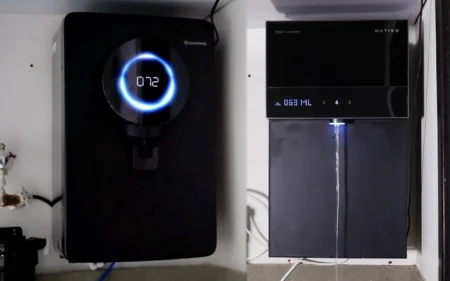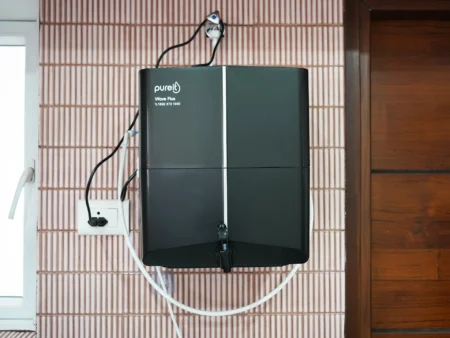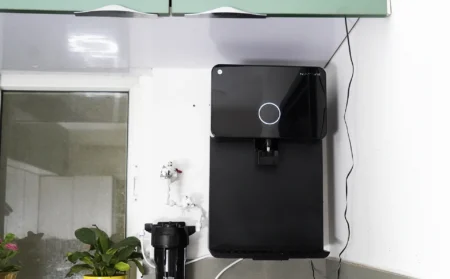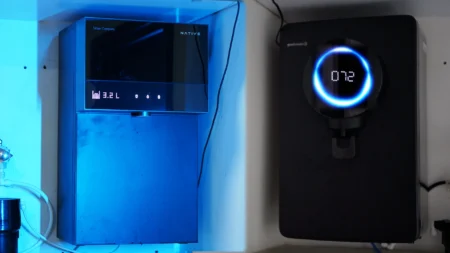


RO, or Reverse Osmosis, is the most common water purification procedure followed by almost everyone in India. RO is essential because of the high levels of TDS and heavy metal contaminants in water. Though the RO process wastes water, most prefer it to alternatives like UV and UF water purification.
Reverse Osmosis is the most effective water purification process to remove dissolved contaminants from source water. This process can remove TDS and heavy metal impurities dissolved in water to provide clean and hygienic drinking water.

How does Reverse Osmosis work?
Reverse Osmosis, as the name suggests, is the reverse of the natural osmosis process. The best example of osmosis is the absorption of water by plant roots. Roots absorb water from the soil. The principle of osmosis is that water or any liquid moves naturally from an area of lower concentration to a higher concentration through a semipermeable membrane.

Reverse Osmosis is the exact opposite of this procedure. Here, the water or liquid moves from an area of heavy concentration (water with TDS and heavy metal impurities) to a low-concentration area through a semipermeable membrane known as the RO membrane.
Since this process is against the forces of nature, it requires additional force to push the water through the membrane. Therefore, RO water purifiers use inbuilt pumps to force the water through the RO membrane. The membrane traps dissolved impurities with molecular weight over 20, allowing water molecules to pass through.
Thus, the final product is pure water without any dissolved impurities. The dissolved contaminants are rejected through a separate outlet as reject water.

This water has a high TDS concentration and is unfit for human consumption. However, you can use it for other purposes like washing utensils, cleaning floors, watering plants, etc.
What is the RO membrane made of?
RO membranes are usually cellulose acetate or poly-sulfone coated with aromatic polyamides. These membranes have a pore size of 0.0001 to 0.0002 microns. Hence, they can trap the minutest dissolved contaminants and purify water.
What does Reverse Osmosis remove?
The RO water purification procedure removes dissolved contaminants. No other water purification can do it.
The ultrafiltration process can remove suspended particles in source water, and ultraviolet treatment eliminates bacteria, viruses, and other harmful microorganisms.
The RO purification process removes TDS and heavy metal impurities like arsenic, lead, antimony, mercury, and other contaminants that can cause severe health problems.
Usually, we do not use RO water purification to remove suspended particles in water. The particles can clog the membrane and render it ineffective. Therefore, top-quality water purifiers use sediment filters, pre-carbon activated filters, and UF membranes before the RO membrane to protect the expensive components and extend the machine’s lifespan.

Reverse Osmosis Changes water taste
The RO water purification process removes TDS from water and purifies it. However, the process removes essential minerals like magnesium, calcium, and manganese from the source water to make it tasteless.
Therefore, water purifier manufacturers reintroduce these lost minerals in various ways like fitting TDS controllers, Mineral enhancer cartridges, etc. These processes replenish the lost minerals and improve the water’s taste.
RO Water Purifier Advantages
- Reverse Osmosis water purification can remove dissolved impurities and is the most recommended procedure for eliminating TDS from water.
- RO water purification can remove almost all the dissolved solids from water and produce water with a pH level of 7.
- RO purification is essential whenever the TDS levels in the water source are more than 300 ppm. The Indian standards stipulate that RO is essential for water with more than 500 ppm TDS levels.
- This water purification is the best for making groundwater potable. Therefore, people residing in coastal areas need RO water purification.
- RO water purification is essential for removing dissolved industrial waste from water sources. In addition, it can deal effectively with heavy dissolved metal impurities like lead, mercury, and arsenic.
- Many municipalities and large gated communities have massive RO water treatment plants to offer RO-purified water to their residents. It eliminates the need for individuals to invest in expensive RO water purifiers.
RO Water Purifier Disadvantages
- The most significant demerit of the RO water purification method is water wastage. The water wastage depends on the TDS levels present in the source water. Usually, the wastage is one glass of water for every glass of water purified.
- RO membranes are more expensive than UF membranes and UV lamps. Hence, an RO water purifier is comparatively more expensive.
- RO membranes use proper maintenance and replacement after around one year. However, since these membranes are expensive, the water purifier’s maintenance costs increase substantially.
- RO water purification changes the water’s taste. Hence, processes like TDS controller and mineral enhancer cartridges are necessary to restore the water taste.
- RO water purification is generally never used as a standalone procedure. Instead, it works with complementing technologies like sediment filtering, pre, and post-carbon-activated filters, and ultraviolet and ultrafiltration procedures.

Reverse Osmosis – Frequently Asked Questions
RO purification is the best way to remove dissolved contaminants from water. Water with heavy TDS levels is unhealthy and harmful for consumption. Therefore, RO-purified water with mineral enhancers is the best solution.
TDS controllers use a process involving introducing source water without RO treatment to the RO-purified water to balance the TDS levels and make it ideal for consumption. TDS controllers are handy when the original TDS in water does not constitute toxic chemicals like mercury and arsenic.
Mineral enhancers use mineral cartridges that introduce essential minerals like calcium, magnesium, etc., into RO-purified water to enhance its taste.
The lifespan of the RO membrane depends on the TDS levels in the source water. Usually, RO membranes can last for four to seven years. However, in areas with high TDS levels, the RO membranes could need replacement annually or once in two years.
Used RO membranes do not have any domestic use. But they are helpful for the nanofiltration of seawater in industrial plants.
It depends on the RO membrane quality and pore thickness. Generally, a decent RO membrane for domestic use costs between Rs 2,000 and Rs 2,500.
Yes. Water with temperatures over 40 degrees Fahrenheit can damage RO membranes. Hence, all RO water purifiers have other pre-filtering arrangements that remove suspended particles and control the water temperature before it flows into the RO membrane.
You must replace the RO membrane when you observe a significant change in the water taste. The Modern Day RO Water Purifiers come with Filter Change Alarms
The ideal TDS levels in drinking water should be between 50 and 150 ppm.