

The moment you walk into a showroom to buy an AC, the salesman will almost always push you towards the 5 star model. “Sir, it saves electricity. In 2–3 years you’ll recover the cost.”
Frankly speaking, that statement is not entirely wrong. But it is not entirely right either.
The reality is more nuanced. Whether a 5-star AC is worth the premium over a 3-star model depends heavily on where you live, how many months you run the AC, and how many hours per day you use it.
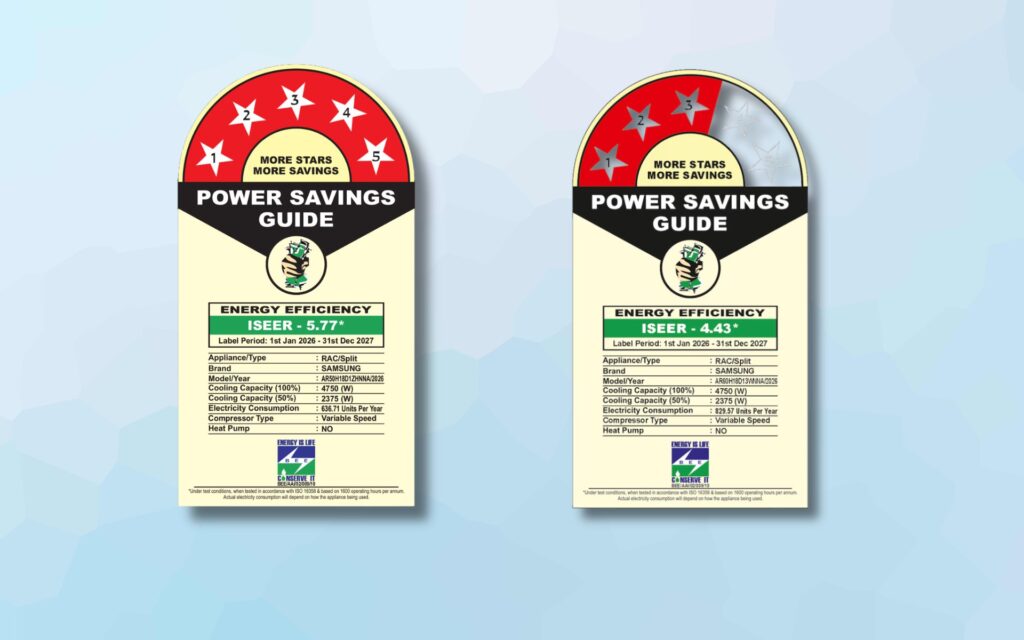
We took two real Samsung 1.5-ton inverter AC models — both 2026 BEE-rated, both Variable Speed compressors — and did the actual math. Let us walk you through everything.
The Two Samsung ACs We Are Comparing
Both models are 1.5-ton Samsung inverter ACs with a 2026 BEE label, valid till December 2027. Same brand, same tonnage, same compressor type. The only difference is the star rating.
| Parameter | Samsung 3 Star | Samsung 5 Star |
|---|---|---|
| Model | AR60H18D13WNNA/2026 | AR50H18D1ZHNNA/2026 |
| Star Rating | 3 Star | 5 Star |
| ISEER | 4.43 | 5.77 |
| Cooling Capacity (100%) | 4750 W | 4750 W |
| Cooling Capacity (50%) | 2375 W | 2375 W |
| Annual Electricity Consumption | 829.57 units/year | 636.71 units/year |
| Compressor Type | Variable Speed | Variable Speed |
| Price (Approx.) | ₹39,990 | ₹47,990 |
This is as clean a comparison as you can get. Same brand, same cooling output, same inverter technology. Just different efficiency levels.
What is ISEER and Why Does It Matter Here?
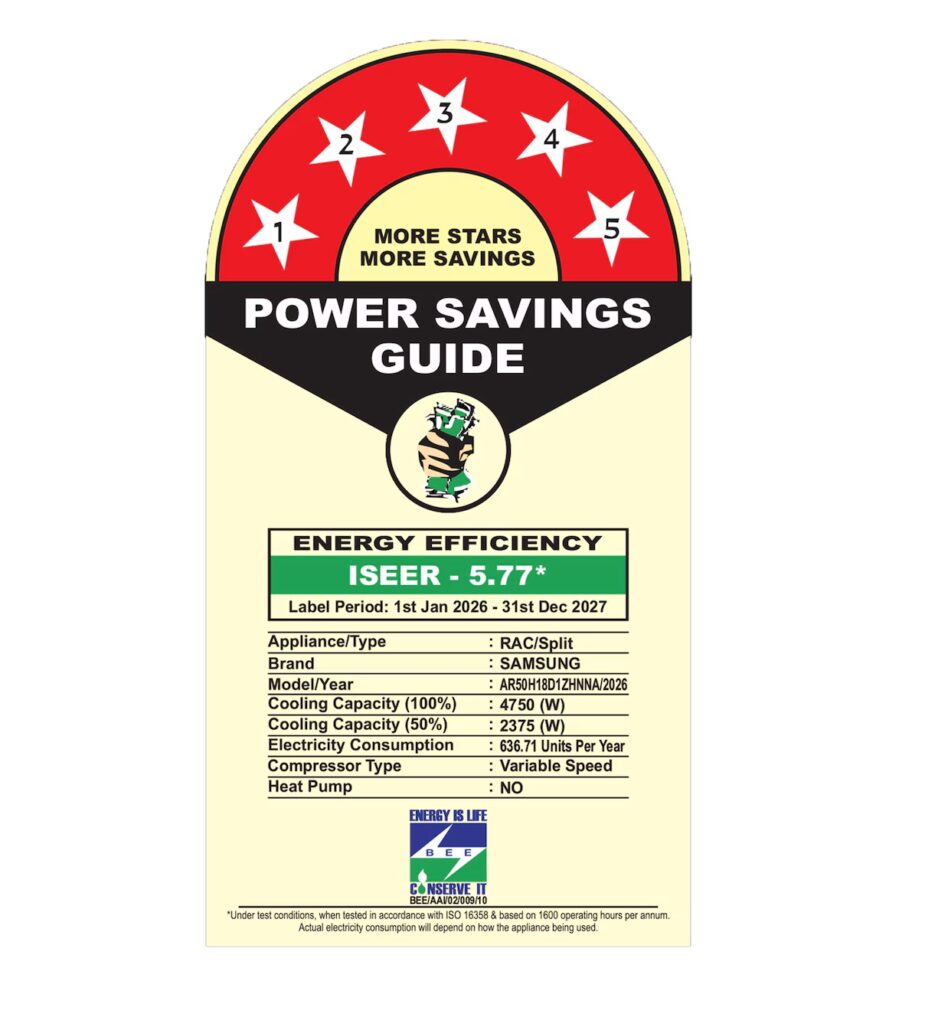
ISEER stands for Indian Seasonal Energy Efficiency Ratio. In simple terms, it tells you how efficiently the AC converts electricity into cooling across the Indian climate — across different seasons, temperatures, and usage patterns.
Higher the ISEER, the more cooling you get per unit of electricity consumed.
The 3-star Samsung has an ISEER of 4.43. The 5-star model has an ISEER of 5.77. That is a 30% jump in efficiency on paper.
But here is what most articles do not tell you — that efficiency advantage only translates into real money if you actually run the AC enough hours and enough months. More on that in a moment.
5 Star AC vs 3 Star AC Power Consumption
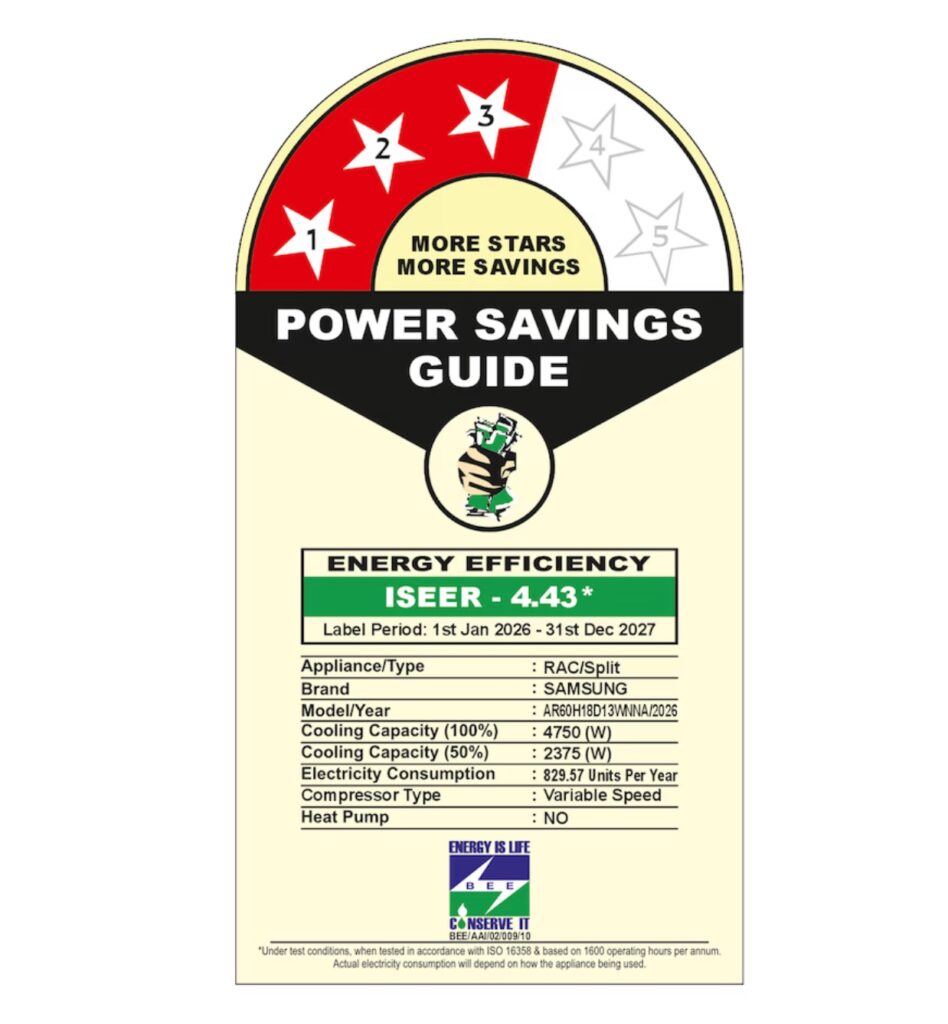
BEE calculates annual electricity consumption assuming 1600 operating hours per year. That works out to roughly 4.4 hours per day, 365 days a year.
| Model | Annual Units (BEE Standard) |
|---|---|
| Samsung 3 Star | 829.57 units |
| Samsung 5 Star | 636.71 units |
| Difference | 192.86 units per year |
At current electricity rates across India:
| Electricity Rate | Annual Savings with 5 Star |
|---|---|
| ₹6 per unit | ₹1,157 per year |
| ₹7 per unit | ₹1,350 per year |
| ₹8 per unit | ₹1,543 per year |
| ₹9 per unit | ₹1,736 per year |
So in a typical year, the 5-star model saves you somewhere between ₹1,150 and ₹1,750 depending on your state’s electricity tariff.
Does the 5 Star AC Cool Better Than 3 Star?
This is the question most buyers forget to ask.
Look at the table again. Both the Samsung 3-star and 5-star models have identical cooling capacity — 4750 W at 100% load and 2375 W at 50% load. The star rating has nothing to do with how fast or how powerfully the AC cools your room.
The star rating only tells you how efficiently the AC uses electricity to deliver that cooling. It does not tell you how much it cools.
So no — buying a 5-star AC will not cool your room faster or better than a 3-star AC of the same tonnage from the same brand. Both will cool the room to the same temperature in roughly the same time.
What changes is how much electricity it burns while doing that job.
When Does 5 Star Actually Make Sense?
The 5-star model costs ₹8,000 more than the 3-star. At ₹1,350 savings per year (at ₹7/unit), here is how long it takes to recover that extra investment.
Payback Period = ₹8,000 ÷ ₹1,350 = ~5.9 years
Nearly 6 years. That is the break-even point under BEE’s standard assumption of 1600 hours per year.
But here is the problem with that assumption — not everyone in India uses their AC for 1600 hours a year. In fact, most people don’t.

Cities Where AC Runs 8–10 Months a Year
Chennai, Visakhapatnam, Kochi, Coimbatore, Nagpur, Ahmedabad, and most coastal cities fall in this category. Here, summers are long and brutal. Even October and November can be warm enough to need an AC at night.
In these cities, the AC easily runs 2,500 to 3,000+ hours per year. Let us recalculate savings at 2,800 hours:
| Electricity Rate | Annual Savings (2800 hrs) |
|---|---|
| ₹7 per unit | ~₹2,380 per year |
| ₹8 per unit | ~₹2,720 per year |
At ₹2,380 savings per year, the ₹8,000 premium is recovered in just 3.3 years. After that, it is pure savings for the remaining 7–8 years of the AC’s life.
For these cities, the 5-star AC is a clear winner.
Cities Where AC Runs Only 2 – 4 Months a Year
Bangalore, Pune, Mysore, Shimla, Dehradun, and many hill cities or moderate-climate cities fall here. Bangalore in particular is famous for its pleasant weather. Most people in Bangalore run their AC only from March to June — roughly 3 months.
At 3 months of usage with 5–6 hours per day, you are looking at roughly 450 to 550 hours per year. Let us recalculate:
| Electricity Rate | Annual Savings (500 hrs) |
|---|---|
| ₹7 per unit | ~₹425 per year |
| ₹8 per unit | ~₹486 per year |
At ₹425 savings per year, recovering ₹8,000 will take you nearly 19 years.
The AC itself has a typical lifespan of 10–12 years. You will never recover the premium. Ever.
For these cities, the 3-star AC is the smarter financial choice.
Cities in the Middle — Delhi, Mumbai, Kolkata, Hyderabad
Delhi has extreme summers but relatively mild September onwards. Mumbai has high humidity but sea breeze makes it bearable for parts of the year. These cities typically run AC for 5–6 months, roughly 900 to 1,200 hours per year.
At 1,000 hours:
| Electricity Rate | Annual Savings (1000 hrs) |
|---|---|
| ₹7 per unit | ~₹845 per year |
| ₹8 per unit | ~₹965 per year |
Payback at ₹845/year savings = ~9.5 years. That is borderline. If you plan to keep the AC for 12+ years and your electricity rate is on the higher side, the 5-star edges out. Otherwise, it is not a compelling case.
Summary — Which One Should You Buy?
| Your Situation | Our Recommendation |
|---|---|
| Chennai, Kochi, Visakhapatnam, Nagpur, Coimbatore, Ahmedabad — 8+ months of AC usage | Buy 5 Star. Payback in 3–4 years, clear savings after that. |
| Delhi, Mumbai, Kolkata, Hyderabad — 5–6 months of AC usage | Borderline. Buy 5 Star only if you’re keeping the AC 12+ years. |
| Bangalore, Pune, hill cities — 2–3 months of AC usage | Buy 3 Star. You will never recover the ₹8,000 premium. |
| High electricity tariff state (₹9+ per unit) | Lean towards 5 Star regardless of city. |
| Budget is tight | 3 Star gives same cooling. Use the ₹8,000 for a stabiliser, extended warranty, or installation. |
One More Thing — Check the ISEER, Not Just the Stars
Here is a tip that will save you from getting fooled at the showroom.
BEE star ratings work in ranges. A 3-star AC can have an ISEER anywhere between 4.30 and 4.99. Similarly, a 5-star AC can start at ISEER 5.60 and go much higher.
Two ACs can both be labeled ‘3 Star’ but have meaningfully different efficiency levels — one at 4.31 and another at 4.95.
Always look at the ISEER number on the BEE label, not just the number of stars. A 3-star AC with ISEER 4.95 is far better than a 3-star AC with ISEER 4.31, even though both carry the same badge.
In our Samsung comparison, the 5-star model has ISEER 5.77 — which is comfortably above the minimum 5.60 required for 5-star certification. That is a good sign.
Final Words
The answer to “5-star or 3-star” is not the same for everyone. It depends on your city, your usage pattern, and your electricity tariff.
If you are in Chennai, Kochi, Visakhapatnam, Nagpur or Ahmedabad, do not think twice — the 5-star pays for itself within 3–4 years and keeps saving for the rest of its life. If you are in Bangalore or Pune running the AC for just a couple of months, the 3-star is the honest, sensible choice. The cooling will be identical. Your pocket will thank you.
No salesman will tell you this. Now you know.
